


 Cart
Cart
 sales@molnova.com



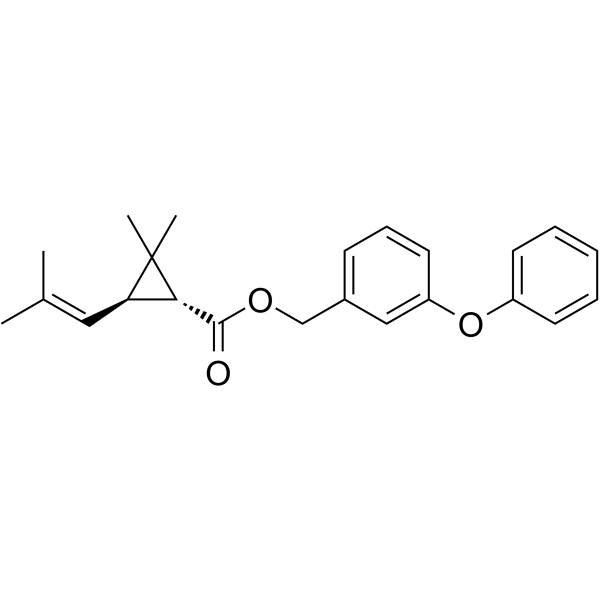
D-Phenothrin
CAS No. 26046-85-5
D-Phenothrin( (-)-trans-Phenothrin )
Catalog No. M26559 CAS No. 26046-85-5
D-Phenothrin is used in veterinary medicine to control pests on animals and to protect crops. D-Phenothrin is an orally effective type II synthetic pyrethroid widely used to kill insects, mosquitoes and human lice.
Purity : >98% (HPLC)
 COA
Datasheet
HNMR
HPLC
MSDS
Handing Instructions
COA
Datasheet
HNMR
HPLC
MSDS
Handing Instructions
| Size | Price / USD | Stock | Quantity |
| 5MG | 46 | Get Quote |


|
| 10MG | 65 | Get Quote |
|
| 25MG | 119 | Get Quote |
|
| 50MG | 168 | Get Quote |
|
| 100MG | 242 | Get Quote |
|
| 200MG | 357 | Get Quote |
|
| 500MG | 537 | Get Quote |
|
| 1G | Get Quote | Get Quote |
|
Biological Information
-
Product NameD-Phenothrin
-
NoteResearch use only, not for human use.
-
Brief DescriptionD-Phenothrin is used in veterinary medicine to control pests on animals and to protect crops. D-Phenothrin is an orally effective type II synthetic pyrethroid widely used to kill insects, mosquitoes and human lice.
-
DescriptionD-Phenothrin is used in veterinary medicine to control pests on animals and to protect crops. D-Phenothrin is an orally effective type II synthetic pyrethroid widely used to kill insects, mosquitoes and human lice.(In Vivo):D-Phenothrin administered to rats intraperitoneally for 14 consecutive days generated free radical species in a dose-dependent manner and caused oxidative DNA damage in the liver and kidney.
-
In Vitro——
-
In VivoD-Phenothrin ((-)-trans-Phenothrin; 25-200 mg/kg; IP; 14 consecutive days) significantly, dose-dependently increases oxidative DNA damage in both organs of animals. D-Phenothrin (100, 300 or 1000 mg/kg/day; p.o.; 3 days) exhibits no potential to cause adverse estrogenic or (anti-)androgenic effects. Animal Model:Male Wistar albino rats (6-week-old, 150-200 g)Dosage:25, 50, 100, 200 mg/kg Administration:IP; 14 consecutive days Result:Had a statistically significant, dose-dependent increase in oxidative DNA damage in both organs of animals.
-
Synonyms(-)-trans-Phenothrin
-
PathwayMicrobiology/Virology
-
TargetParasite
-
RecptorAkt| CB1| Human Endogenous Metabolite| PPARγ
-
Research Area——
-
Indication——
Chemical Information
-
CAS Number26046-85-5
-
Formula Weight350.458
-
Molecular FormulaC23H26O3
-
Purity>98% (HPLC)
-
Solubility——
-
SMILESCC(C)=C[C@@H]1[C@@H](C(=O)OCc2cccc(Oc3ccccc3)c2)C1(C)C
-
Chemical Name——
Shipping & Storage Information
-
Storage(-20℃)
-
ShippingWith Ice Pack
-
Stability≥ 2 years
Reference
1.Wang S, et al. N-Oleoyl glycine, a lipoamino acid, stimulates adipogenesis associated with activation of CB1 receptor and Akt signaling pathway in 3T3-L1 adipocyte. Biochem Biophys Res Commun. 2015 Oct 23;466(3):438-43.
molnova catalog



related products
-
AQ-13 dihydrochlorid...
AQ-13 dihydrochloride is an antimalarial drug. It is effective against drug-resistant strains of Plasmodium falciparum.
-
Oxamniquine
Oxamniquine is a potent agent for the treatment of schistosomiasis.
-
N-(2-Hydroxypropyl)m...
N-(2-Hydroxypropyl)methacrylamide is used in the synthesis of copolymers for the targeted delivery of antileishmanial agents in Visceral leishmaniasis.
