


 Cart
Cart
 sales@molnova.com



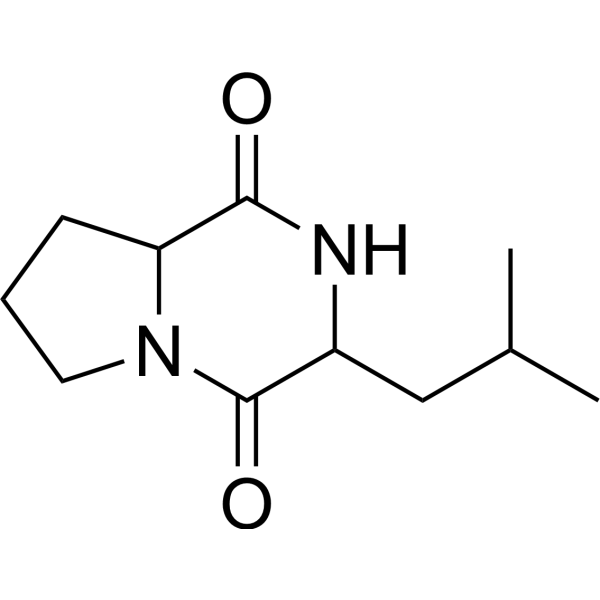
Cyclo(Pro-Leu)
CAS No. 5654-86-4
Cyclo(Pro-Leu)( Cyclo(leucyloprolyl) | Cyclo-L-leu-L-pro | Cyclo-L-prolyl-L-leucine )
Catalog No. M29035 CAS No. 5654-86-4
Cyclo(Pro-Leu) has brine shrimp lethality.
Purity : >98% (HPLC)
 COA
Datasheet
HNMR
HPLC
MSDS
Handing Instructions
COA
Datasheet
HNMR
HPLC
MSDS
Handing Instructions
| Size | Price / USD | Stock | Quantity |
| 5MG | 45 | Get Quote |


|
| 10MG | 68 | Get Quote |
|
| 25MG | 115 | Get Quote |
|
| 50MG | 173 | Get Quote |
|
| 100MG | 258 | Get Quote |
|
| 200MG | 388 | Get Quote |
|
| 500MG | Get Quote | Get Quote |
|
| 1G | Get Quote | Get Quote |
|
Biological Information
-
Product NameCyclo(Pro-Leu)
-
NoteResearch use only, not for human use.
-
Brief DescriptionCyclo(Pro-Leu) has brine shrimp lethality.
-
DescriptionCyclo(Pro-Leu) has brine shrimp lethality.
-
In VitroCyclo(Pro-Leu) (compound 7) (1.23 μg/mL-300 μg/mL; 48 h) has cytotoxic activity for HT-29, MCF-7, A375, K562, and NCM460 cell lines with IC50 values of 101.56 μM, 78.78 μM, 51.13 μM, 21.72 μM and 775.86 μM, respectively.
-
In Vivo——
-
SynonymsCyclo(leucyloprolyl) | Cyclo-L-leu-L-pro | Cyclo-L-prolyl-L-leucine
-
PathwayOthers
-
TargetOther Targets
-
Recptor——
-
Research Area——
-
Indication——
Chemical Information
-
CAS Number5654-86-4
-
Formula Weight210.27
-
Molecular FormulaC11H18N2O2
-
Purity>98% (HPLC)
-
Solubility——
-
SMILESCC(C)CC1NC(=O)C2CCCN2C1=O
-
Chemical Name——
Shipping & Storage Information
-
Storage(-20℃)
-
ShippingWith Ice Pack
-
Stability≥ 2 years
Reference
molnova catalog



related products
-
MMP-7 Substrate I, f...
Dnp-RPLALWRS is a biological active peptide. (matrilysin substrate)
-
α-Factor Mating Pher...
The alpha factor pheromone arrests yeast in the G1 phase of their cell cycle. Alpha Factor Mating Pheromone induces the expression of mating genes, changes in nuclear architecture, and polarzes growth toward the mating partner.
-
Xanthiside
Xanthiside is a natural product.
