


 Cart
Cart
 sales@molnova.com



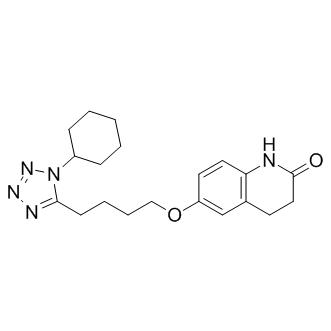
Cilostazol
CAS No. 73963-72-1
Cilostazol( OPC 13013 | OPC 21 )
Catalog No. M15825 CAS No. 73963-72-1
Cilostazol (OPC 13013, OPC 21) is a potent inhibitor of PDE3A with IC50 of 0.2 uM; inhibits platelet aggregation and has considerable antithrombotic effects in vivo.
Purity : >98% (HPLC)
 COA
Datasheet
HNMR
HPLC
MSDS
Handing Instructions
COA
Datasheet
HNMR
HPLC
MSDS
Handing Instructions
| Size | Price / USD | Stock | Quantity |
| 25MG | 35 | In Stock |


|
| 50MG | 48 | In Stock |
|
| 100MG | 69 | In Stock |
|
| 200MG | Get Quote | In Stock |
|
| 500MG | Get Quote | In Stock |
|
| 1G | Get Quote | In Stock |
|
Biological Information
-
Product NameCilostazol
-
NoteResearch use only, not for human use.
-
Brief DescriptionCilostazol (OPC 13013, OPC 21) is a potent inhibitor of PDE3A with IC50 of 0.2 uM; inhibits platelet aggregation and has considerable antithrombotic effects in vivo.
-
DescriptionCilostazol (OPC 13013, OPC 21) is a potent inhibitor of PDE3A with IC50 of 0.2 uM; inhibits platelet aggregation and has considerable antithrombotic effects in vivo. The compound relaxes vascular smooth muscle and inhibits mitogenesis and migration of vascular smooth muscle cells; also upregulates autophagy via SIRT1 activation, has preventive effects on various central nervous system (CNS) diseases.Stroke Approved(In Vitro):Cilostazol selectively inhibits cGMP-inhibited phosphodiesterase (PDE 3) and is a potent inhibitor of platelet aggregation induced by various agonists.Cilostazol inhibits stress-induced human platelet aggregation (SIPA) dose-dependently, with an IC50 of 15 μM for SIPA, and with a similar IC50 of 12.5 μM for ADP-induced platelet aggregation.Cilostazol directly and effectively inhibits the activation of HSC but not of Kupffer cells.(In Vivo):Cilostazol (clinically used doses; p.o.; for 2 weeks) could alleviate CCl4 -induced hepatic fibrogenesis in vivo, presumably due to its direct effect to suppress HSC activation.Cilostazol (intraperitoneal injection; 10 mg/kg; 7 consecutive days after ischemia) attenuates neurological dysfunctions, brain atrophy and infarct volume, and inhibits astrocyte proliferation/glial scar formation and accelerated the angiogenesis in the ischemic boundary zone 7 and 28 days after ischemia.
-
In Vitro——
-
In VivoAnimal Model:Male C57BL/6J mice Dosage:0.1% w/w, 0.3% w/w Administration:Oral administration; fed a normal diet for 2 weeks Result:Exhibited a lesser fibrotic area than control groups.Animal Model:Male ICR mice Dosage:10 mg/kg Administration:Intraperitoneal injection;7 consecutive days after ischemia Result:Had an effectve effects for the late injury.
-
SynonymsOPC 13013 | OPC 21
-
PathwayAngiogenesis
-
TargetPDE
-
RecptorPDE3
-
Research AreaNeurological Disease
-
IndicationStroke
Chemical Information
-
CAS Number73963-72-1
-
Formula Weight369.4607
-
Molecular FormulaC20H27N5O2
-
Purity>98% (HPLC)
-
Solubility10 mM in DMSO
-
SMILESC1CCC(CC1)N2C(=NN=N2)CCCCOC3=CC4=C(C=C3)NC(=O)CC4
-
Chemical Name2(1H)-Quinolinone, 6-[4-(1-cyclohexyl-1H-tetrazol-5-yl)butoxy]-3,4-dihydro-
Shipping & Storage Information
-
Storage(-20℃)
-
ShippingWith Ice Pack
-
Stability≥ 2 years
Reference
1. Schr?r K, et al. Diabetes Obes Metab. 2002 Mar;4 Suppl 2:S14-9.
2. Lee HR, et al. PLoS One. 2015 Aug 5;10(8):e0134486.
3. Qi DS, et al. Brain Res. 2016 Dec 15;1653:67-74.
molnova catalog



related products
-
PF 05180999
PF-05180999 (PF 5180999) is a potent, selective, brain-penetrating and orally bioavailable phosphodiesterase 2A (PDE2A) inhibitor with IC50 of 1 nM.
-
Trequinsin hydrochlo...
Trequinsin hydrochloride (HL 725) is a potent, cell-permeable, orally active inhibitor of cGMP-inhibited phosphodiesterase (PCE3 IC50=250 pM).
-
Resibufogenin
Resibufogenin is a cytotoxic steroid isolated from the Chinese drug ChanSu. Resibufogenin can inhibit rectifier potassium current ( I K ) and transient potassium current ( I A ), it has pathological effects on central nervous system.
