


 Cart
Cart
 sales@molnova.com



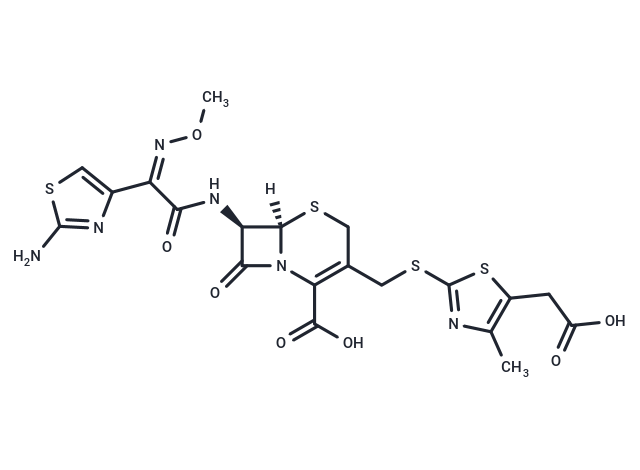
Cefodizime
CAS No. 69739-16-8
Cefodizime( —— )
Catalog No. M33312 CAS No. 69739-16-8
Cefodizime is a new cephalosporin antibiotic with a wide range of biological activities.Cefodizime is non-toxic to the kidneys and is well tolerated with immunomodulatory activity.
Purity : >98% (HPLC)
 COA
Datasheet
HNMR
HPLC
MSDS
Handing Instructions
COA
Datasheet
HNMR
HPLC
MSDS
Handing Instructions
| Size | Price / USD | Stock | Quantity |
| 10MG | 37 | In Stock |


|
| 25MG | 49 | In Stock |
|
| 50MG | 59 | In Stock |
|
| 100MG | 80 | In Stock |
|
| 500MG | 197 | In Stock |
|
| 1G | Get Quote | In Stock |
|
Biological Information
-
Product NameCefodizime
-
NoteResearch use only, not for human use.
-
Brief DescriptionCefodizime is a new cephalosporin antibiotic with a wide range of biological activities.Cefodizime is non-toxic to the kidneys and is well tolerated with immunomodulatory activity.
-
DescriptionCefodizime is a third generation cephalosporin antibiotic with a broad spectrum of antibacterial activity. Cefodizime has no renal toxic effect, good tolerance and immune regulation activity, and has the potential for severe infections of the respiratory and urinary tracts.
-
In VitroEnterobacteriaceae including Escherichia coli, Klebsiella pneumoniae, Morganella morgan ii, Proteus mirabilis, Proteus vulgaris, Shigella sonnei, Yersinia enterocolitica and Salmonella species are all consistently sensitive to Cefodizime in vitro. Cefodizime has marginal but variable inhibitory activity against Citrobacter species including Citrobacter freundii, and Serratia marcescens. Cefodizime inhibits other Gram-negative bacteria including Haemophilus irifluenzae, Moraxella catarrhalis, Neisseria gonorrhoeae and Neisseria meningitidis. Cefodizime is a bactericidal antibiotic having high affinity for penicillin-binding proteins lA/B, 2 and 3 of E. coli. The in vitro concentrations of Cefodizime resulting in bactericidal activity against susceptible strains of Gram-positive and Gram-negative bacteria are generally similar to the minimum inhibitory concentrations.
-
In VivoIn experimentally-induced K. pneumoniae respiratory tract infections in mice, Cefodizime has activity comparable to Cefotaxime and Ceftazidime, and greater than that of Cefoperazone, Latamoxef, Cefuroxime or cefazolin for 8 hours after a single subcutaneous dose of 50 mg/kg. However, unlike these cephalosporins, Cefodizime continues to demonstrate pronounced bactericidal activity for at least 48 hours after a single injection. Complete bacterial clearance from the lung is achieved within 48 hours in 50% of the mice although Cefodizime is no longer detectable in the serum.
-
Synonyms——
-
PathwayGPCR/G Protein
-
TargetAntibacterial
-
RecptorAntibacterial | Antibiotic
-
Research Area——
-
Indication——
Chemical Information
-
CAS Number69739-16-8
-
Formula Weight584.67
-
Molecular FormulaC20H20N6O7S4
-
Purity>98% (HPLC)
-
SolubilityIn Vitro:?DMSO : 20.83 mg/mL (35.63 mM; Ultrasonic )
-
SMILESC(O)(=O)C=1N2[C@@]([C@H](NC(/C(=N\OC)/C=3N=C(N)SC3)=O)C2=O)(SCC1CSC=4SC(CC(O)=O)=C(C)N4)[H]
-
Chemical Name——
Shipping & Storage Information
-
Storage(-20℃)
-
ShippingWith Ice Pack
-
Stability≥ 2 years
Reference
1. Barradell LB, et al. Cefodizime. A review of its antibacterial activity, pharmacokinetic properties and therapeutic use. Drugs. 1992 Nov;44(5):800-34.?
molnova catalog



related products
-
Maduramycin Ammonium
Maduramycin Ammonium is an anticoccidial agent for the the treatment of Eimeria spp. E. adenoeides E. gallopavonis and E. dispersa infection.
-
XF-73
XF-73 (Exeporfinium chloride) is a novel broad-spectrum antibacterial agent that inhibits a range of gram-positive bacterial species (MIC=0.25-4 mg/mL).
-
Amorolfine HCL
Amorolfine HCL is an antifungal reagent. It exerts the antifungal activity by selectively interrupting two steps in the pathway of ergosterol synthesis and eventually disrupting the function and structure of fungal cell membrane. Amorolfine, a morpholine antifungal drug, can inhibit D14 reductase and D7-D8 isomerase.
