


 Cart
Cart
 sales@molnova.com



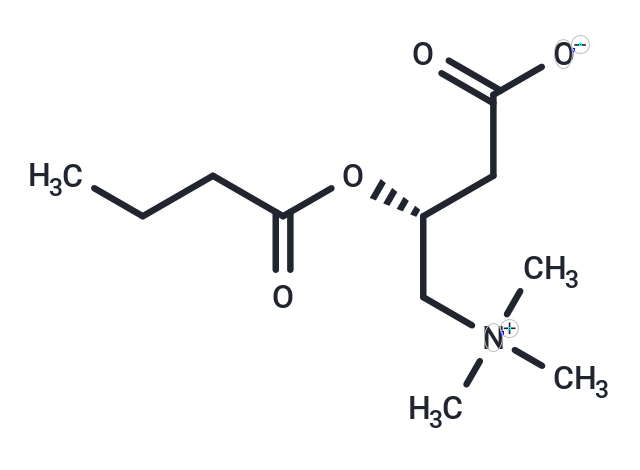
Butyrylcarnitine
CAS No. 25576-40-3
Butyrylcarnitine( —— )
Catalog No. M33300 CAS No. 25576-40-3
Butyrylcarnitine is a plasma metabolite that is an indicator of abnormal metabolism due to disease and is used in the diagnosis of heart failure and pancreatic cysts.
Purity : >98% (HPLC)
 COA
Datasheet
HNMR
HPLC
MSDS
Handing Instructions
COA
Datasheet
HNMR
HPLC
MSDS
Handing Instructions
| Size | Price / USD | Stock | Quantity |
| 5MG | 45 | Get Quote |


|
| 10MG | 68 | Get Quote |
|
| 25MG | 131 | Get Quote |
|
| 500MG | Get Quote | Get Quote |
|
| 1G | Get Quote | Get Quote |
|
Biological Information
-
Product NameButyrylcarnitine
-
NoteResearch use only, not for human use.
-
Brief DescriptionButyrylcarnitine is a plasma metabolite that is an indicator of abnormal metabolism due to disease and is used in the diagnosis of heart failure and pancreatic cysts.
-
DescriptionButyrylcarnitine is a metabolite in plasma, acts as a biomarker to improve the diagnosis and prognosis of heart failure, and is indicative of anomalous lipid and energy metabolism.
-
In Vitro——
-
In Vivo——
-
Synonyms——
-
PathwayProteasome/Ubiquitin
-
TargetEndogenous Metabolite
-
RecptorEndogenous Metabolite
-
Research Area——
-
Indication——
Chemical Information
-
CAS Number25576-40-3
-
Formula Weight231.29
-
Molecular FormulaC11H21NO4
-
Purity>98% (HPLC)
-
SolubilityIn Vitro:?H2O : ≥ 100 mg/mL (432.36 mM)
-
SMILESCCCC(=O)O[C@H](CC([O-])=O)C[N+](C)(C)C
-
Chemical Name——
Shipping & Storage Information
-
Storage(-20℃)
-
ShippingWith Ice Pack
-
Stability≥ 2 years
Reference
1. Cheng ML, et al. Metabolic disturbances identified in plasma are associated with outcomes in patients with heart failure: diagnostic and prognostic value of metabolomics. J Am Coll Cardiol. 2015 Apr 21;65(15):1509-20.?
molnova catalog



related products
-
Glycerol 3-phosphate...
Glycerol 3-phosphate biscyclohexylammonium salt is an endogenous metabolite produced by cytosolic glycerol 3-phosphate dehydrogenase pathway.
-
Creatine D3 hydrate
Creatine D3 hydrate is a deuterium labeled Creatine hydrate. Creatine hydrate is pivotal in energy metabolism of muscle and brain cells, both in physiological and in pathological conditions.
-
5-Methyltetrahydrofo...
5-Methyltetrahydrofolic acid is a biologically active form of folic acid and a methylated derivate of tetrahydrofolate.
