


 Cart
Cart
 sales@molnova.com



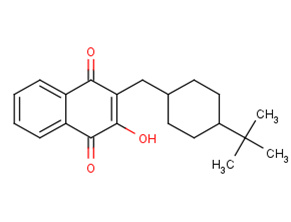
Buparvaquone
CAS No. 88426-33-9
Buparvaquone( —— )
Catalog No. M19227 CAS No. 88426-33-9
Buparvaquone is a hydroxynaphthoquinone antiprotozoal drug related to parvaquone and atovaquone.
Purity : >98% (HPLC)
 COA
Datasheet
HNMR
HPLC
MSDS
Handing Instructions
COA
Datasheet
HNMR
HPLC
MSDS
Handing Instructions
| Size | Price / USD | Stock | Quantity |
| 10MG | 38 | In Stock |


|
| 50MG | 52 | In Stock |
|
| 100MG | 67 | In Stock |
|
| 200MG | Get Quote | In Stock |
|
| 500MG | Get Quote | In Stock |
|
| 1G | Get Quote | In Stock |
|
Biological Information
-
Product NameBuparvaquone
-
NoteResearch use only, not for human use.
-
Brief DescriptionBuparvaquone is a hydroxynaphthoquinone antiprotozoal drug related to parvaquone and atovaquone.
-
DescriptionBuparvaquone is a hydroxynaphthoquinone antiprotozoal drug related to parvaquone and atovaquone.(In Vitro):In 4-day proliferation assays, buparvaquone efficiently inhibits N.?caninum tachyzoite replication(IC50=4.9?nM; IC100=100?nM). Buparvaquone is significantly selective against L. (L.) infantum chagasi intracellular amastigotes, with an IC50 value of 1.5 μM. Other cutaneous species are also susceptible to buparvaquone, with IC50 values in the range 1-4 μM.(In Vivo):Treatment of N.?caninum infected mice with buparvaquone (100?mg/kg) either by intraperitoneal injection or gavage prevents neosporosis symptoms in 4 out of 6 mice in the intraperitoneally treated group, and in 6 out of 7 mice in the group receiving oral treatment. Both a hydrous gel and water-in-oil emulsion of buparvaquone significantly reduce cutaneous parasite burden and lesion size, compared with the untreated control.
-
In VitroIn 4-day proliferation assays, buparvaquone efficiently inhibits N.?caninum tachyzoite replication(IC50=4.9?nM; IC100=100?nM). Buparvaquone is significantly selective against L. (L.) infantum chagasi intracellular amastigotes, with an IC50 value of 1.5 μM. Other cutaneous species are also susceptible to buparvaquone, with IC50 values in the range 1-4 μM.
-
In VivoTreatment of N.?caninum infected mice with buparvaquone (100?mg/kg) either by intraperitoneal injection or gavage prevents neosporosis symptoms in 4 out of 6 mice in the intraperitoneally treated group, and in 6 out of 7 mice in the group receiving oral treatment. Both a hydrous gel and water-in-oil emulsion of buparvaquone significantly reduce cutaneous parasite burden and lesion size, compared with the untreated control.
-
Synonyms——
-
PathwayOthers
-
TargetOther Targets
-
Recptorothers
-
Research AreaInfection
-
Indication——
Chemical Information
-
CAS Number88426-33-9
-
Formula Weight326.44
-
Molecular FormulaC21H26O3
-
Purity>98% (HPLC)
-
SolubilityDMSO : 33.33 mg/mL 102.10 mM
-
SMILESCC(C)(C)C1CCC(CC2=C(O)C(=O)c3ccccc3C2=O)CC1
-
Chemical Name——
Shipping & Storage Information
-
Storage(-20℃)
-
ShippingWith Ice Pack
-
Stability≥ 2 years
Reference
1.Müller J, et al. Buparvaquone is active against Neospora caninum in vitro and in experimentally infected mice. Int J Parasitol Drugs Drug Resist. 2015 Feb 13;5(1):16-25.
molnova catalog



related products
-
Moluccanin
Moluccanin is a natural product isolated from Aleurites moluccana.
-
Edotreotide
Edotreotide gallium Ga-68 is an 8 amino acid peptide bound to the chelator 1,4,7,10-tetraazacyclododecane-1,4,7,10-tetraacetic acid (DOTA).
-
Bisoctrizole
Bisoctrizole is a benzotriazole-based organic compound that is added to sunscreens to absorb UV rays.
