


 Cart
Cart
 sales@molnova.com



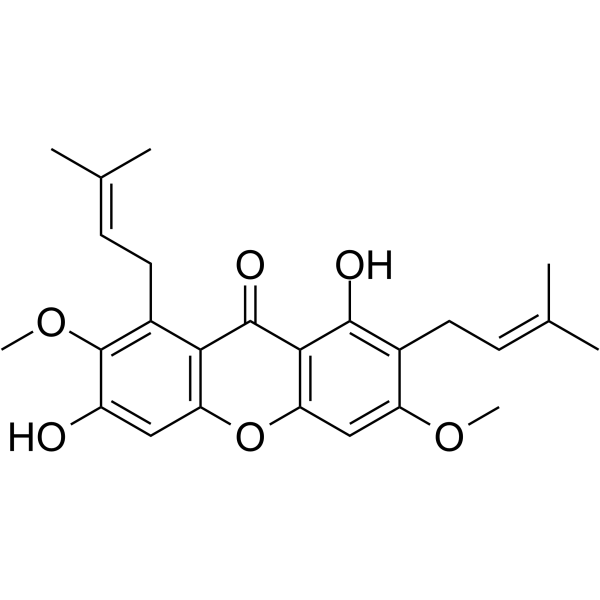
Beta-mangostin
CAS No. 20931-37-7
Beta-mangostin( β-Mangostin )
Catalog No. M29039 CAS No. 20931-37-7
Beta-Mangostin (β-Mangostin) is a xanthone compound with antibacterial and antimalarial activities.
Purity : >98% (HPLC)
 COA
Datasheet
HNMR
HPLC
MSDS
Handing Instructions
COA
Datasheet
HNMR
HPLC
MSDS
Handing Instructions
| Size | Price / USD | Stock | Quantity |
| 5MG | 167 | Get Quote |


|
| 10MG | 246 | Get Quote |
|
| 25MG | 413 | Get Quote |
|
| 50MG | 606 | Get Quote |
|
| 100MG | Get Quote | Get Quote |
|
| 200MG | Get Quote | Get Quote |
|
| 500MG | Get Quote | Get Quote |
|
| 1G | Get Quote | Get Quote |
|
Biological Information
-
Product NameBeta-mangostin
-
NoteResearch use only, not for human use.
-
Brief DescriptionBeta-Mangostin (β-Mangostin) is a xanthone compound with antibacterial and antimalarial activities.
-
DescriptionBeta-Mangostin (β-Mangostin) is a xanthone compound with antibacterial and antimalarial activities. Beta-Mangostin (β-Mangostin) present in Cratoxylum arborescens and exhibits antimycobacterial activity against Mycobacterium tuberculosis with an MIC of 6.25 μg/mL. Beta-Mangostin possesses in vitro antimalarial activity against Plasmodium falciparum, with an IC50 of 3.00 μg/mL. beta-Mangostin has potent anticancer activity against various cancers (such as hepatocellular carcinoma, leukaemic).(In Vitro):Beta-Mangostin activates the intrinsic apoptosis pathway through reactive oxygen species with downregulation of the HSP70 gene in the HL60 cells associated with a G0/G1 cell-cycle arrest.
-
In Vitrobeta-Mangostin activates the intrinsic apoptosis pathway through reactive oxygen species with downregulation of the HSP70 gene in the HL60 cells associated with a G0/G1 cell-cycle arrest.
-
In Vivo——
-
Synonymsβ-Mangostin
-
PathwayApoptosis
-
TargetApoptosis
-
RecptorApoptosis
-
Research Area——
-
Indication——
Chemical Information
-
CAS Number20931-37-7
-
Formula Weight424.493
-
Molecular FormulaC25H28O6
-
Purity>98% (HPLC)
-
SolubilityIn Vitro:?DMSO : 25 mg/mL (58.89 mM)
-
SMILESCOc1cc2oc3cc(O)c(OC)c(CC=C(C)C)c3c(=O)c2c(O)c1CC=C(C)C
-
Chemical Name——
Shipping & Storage Information
-
Storage(-20℃)
-
ShippingWith Ice Pack
-
Stability≥ 2 years
Reference



-
Triglycidyl isocyanu...
Triglycidyl isocyanurate is a triazene triepoxide with antineoplastic and antiangiogenic activity. It inhibits growth of human non-small cell lung cancer cells by activating p53. Triglycidyl isocyanurate alkylates and cross-links DNA, thereby inhibiting DNA replication. It induces cell apoptosis and can be used for cancer research.
-
Curzerene
Curzerene is a sesquiterpene is isolated from the rhizome of Curculigo orchioides Gaertn with anti-cancer activity. Curzerene induces cell apoptosis[1].Curzerene inhibits glutathione S-transferase A1 (GSTA1) mRNA and protein expression.
-
Sparfosic Acid
Sparfosic Acid (Acide sparfosique) is an aspartate carbamoyltransferase inhibitor with antitumor activity and can be used to study advanced renal cell carcinoma.
