


 Cart
Cart
 sales@molnova.com



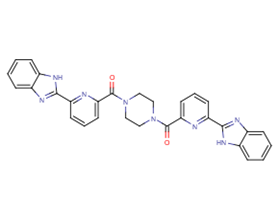
BT-11
CAS No. 1912399-75-7
BT-11( —— )
Catalog No. M17401 CAS No. 1912399-75-7
BT-11 is an orally available LANCL2 binding compound. It is used in the therapy of inflammatory bowel disease.
Purity : >98% (HPLC)
 COA
Datasheet
HNMR
HPLC
MSDS
Handing Instructions
COA
Datasheet
HNMR
HPLC
MSDS
Handing Instructions
| Size | Price / USD | Stock | Quantity |
| 2MG | 77 | In Stock |


|
| 5MG | 120 | In Stock |
|
| 10MG | 179 | In Stock |
|
| 25MG | 323 | In Stock |
|
| 50MG | 588 | In Stock |
|
| 100MG | Get Quote | In Stock |
|
| 200MG | Get Quote | In Stock |
|
| 500MG | Get Quote | In Stock |
|
| 1G | Get Quote | In Stock |
|
Biological Information
-
Product NameBT-11
-
NoteResearch use only, not for human use.
-
Brief DescriptionBT-11 is an orally available LANCL2 binding compound. It is used in the therapy of inflammatory bowel disease.
-
DescriptionBT-11 is an orally available LANCL2 binding compound. It is used in the therapy of inflammatory bowel disease.
-
In Vitro——
-
In Vivo——
-
Synonyms——
-
PathwayAngiogenesis
-
TargetJAK
-
RecptorLANCL2
-
Research Area——
-
Indication——
Chemical Information
-
CAS Number1912399-75-7
-
Formula Weight528.56
-
Molecular FormulaC30H24N8O2
-
Purity>98% (HPLC)
-
SolubilityDMSO : ≥ 30 mg/mL; 56.76 mM
-
SMILESO=C(N1CCN(C(=O)c2nc(c3nc4ccccc4[nH]3)ccc2)CC1)c1nc(c2nc3ccccc3[nH]2)ccc1
-
Chemical Name——
Shipping & Storage Information
-
Storage(-20℃)
-
ShippingWith Ice Pack
-
Stability≥ 2 years
Reference
1. Carbo A, et al. J Med Chem. 2016 Nov 23;59(22):10113-10126.
molnova catalog



related products
-
ZM39923
ZM39923 is a potent, selective JAK3 inhibitor with pIC50 of 7.1, also potently inhibits human tissue transglutaminase (TGM2) with IC50 of 10 nM.
-
Axltide
Axltide is based on the mouse Insulin receptor substrate 1 (amino acid 979-989).Peptide sequence (KKSRGDYMTMQIG) is based on the mouse Insulin receptor substrate 1 (amino acid 979-989).
-
NVP-BSK805 dihydroch...
NVP-BSK805 dihydrochloride is an effective and selective inhibitor of JAK2 with IC50s of 0.5 nM, 10.76 nM, 18.68 nM, and 31.63 nM for JAK2, TYK2, JAK3, and JAK1.
