


 Cart
Cart
 sales@molnova.com



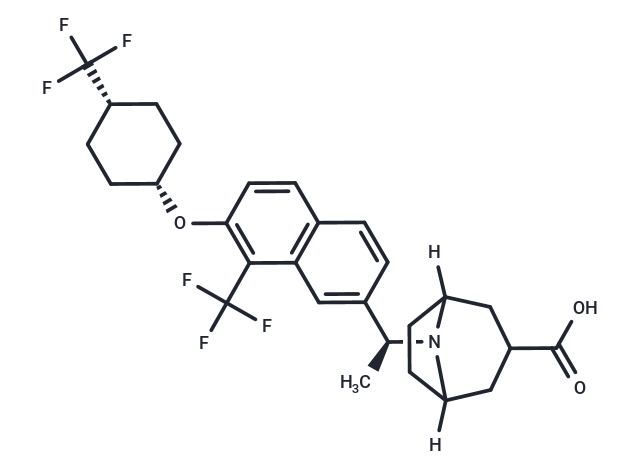
BIO-32546
CAS No. 1548743-66-3
BIO-32546( —— )
Catalog No. M32810 CAS No. 1548743-66-3
BIO-32546 (S-isomer) is a highly potent regulator of autotaxin (ATX) with an IC50 value of 1 nM.
Purity : >98% (HPLC)
 COA
Datasheet
HNMR
HPLC
MSDS
Handing Instructions
COA
Datasheet
HNMR
HPLC
MSDS
Handing Instructions
| Size | Price / USD | Stock | Quantity |
| 2MG | 354 | Get Quote |


|
| 5MG | 550 | Get Quote |
|
| 10MG | 905 | Get Quote |
|
| 25MG | 1831 | Get Quote |
|
| 50MG | 2935 | Get Quote |
|
| 100MG | 4617 | Get Quote |
|
| 500MG | Get Quote | Get Quote |
|
| 1G | Get Quote | Get Quote |
|
Biological Information
-
Product NameBIO-32546
-
NoteResearch use only, not for human use.
-
Brief DescriptionBIO-32546 (S-isomer) is a highly potent regulator of autotaxin (ATX) with an IC50 value of 1 nM.
-
DescriptionBIO-32546 (example 12b, S-isomer) is an autotaxin (ATX) modulator (IC50: 1 nM), extracted from the patent US20170158687A1.
-
In Vitro——
-
In Vivo——
-
Synonyms——
-
PathwayAngiogenesis
-
TargetPDE
-
RecptorPDE
-
Research Area——
-
Indication——
Chemical Information
-
CAS Number1548743-66-3
-
Formula Weight543.54
-
Molecular FormulaC28H31F6NO3
-
Purity>98% (HPLC)
-
SolubilityIn Vitro:?DMSO : 100 mg/mL (183.98 mM; Ultrasonic )
-
SMILESC(F)(F)(F)C=1C2=C(C=CC1O[C@@H]3CC[C@H](C(F)(F)F)CC3)C=CC([C@H](C)N4C5(CC(C(O)=O)CC4(CC5)[H])[H])=C2
-
Chemical Name——
Shipping & Storage Information
-
Storage(-20℃)
-
ShippingWith Ice Pack
-
Stability≥ 2 years
Reference
1. Kevin M. Guckian, et al. Atx modulating agents. Patent. US20170158687A1.
molnova catalog



related products
-
Autotaxin-IN-3
Autotaxin-IN-3 is an Autotaxin(ATX) inhibitor (IC50: 2.4 nM) sourced from patent WO2018212534A1 (compound 33).
-
Torbafylline
Torbafylline, a xanthine derivative, is a phosphodiesterase (PDE) inhibitor that attenuates burn-induced protein hydrolysis in rat skeletal muscle through activation of the PDE4/cAMP/EPAC/PI3K/Akt pathway.
-
OPC18750 HCl
OPC18750 HCl is a potential phosphodiesterase inhibitor with positive inotropic effects that can be used to study asthma, cancer, diabetes, and psychiatric disorders.
