


 Cart
Cart
 sales@molnova.com



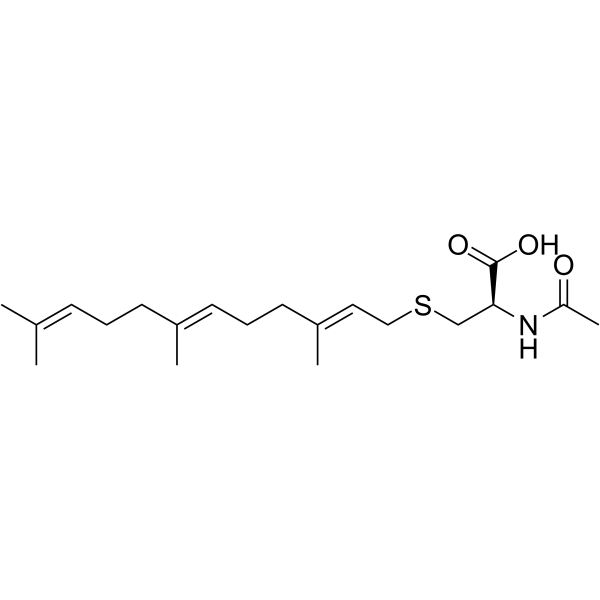
Arazine
CAS No. 135304-07-3
Arazine( N-Acetyl-S-farnesyl-L-cysteine )
Catalog No. M26060 CAS No. 135304-07-3
Arazine can be a a substrate for isoprenylcysteine methyltransferase by competing with prenylated G protein or its receptors site. Arazine is a cell-permeable modulator of G protein and GPCR signaling.
Purity : >98% (HPLC)
 COA
Datasheet
HNMR
HPLC
MSDS
Handing Instructions
COA
Datasheet
HNMR
HPLC
MSDS
Handing Instructions
| Size | Price / USD | Stock | Quantity |
| 5MG | 231 | Get Quote |


|
| 10MG | 341 | Get Quote |
|
| 100MG | Get Quote | Get Quote |
|
| 200MG | Get Quote | Get Quote |
|
| 500MG | Get Quote | Get Quote |
|
| 1G | Get Quote | Get Quote |
|
Biological Information
-
Product NameArazine
-
NoteResearch use only, not for human use.
-
Brief DescriptionArazine can be a a substrate for isoprenylcysteine methyltransferase by competing with prenylated G protein or its receptors site. Arazine is a cell-permeable modulator of G protein and GPCR signaling.
-
DescriptionArazine can be a a substrate for isoprenylcysteine methyltransferase by competing with prenylated G protein or its receptors site. Arazine is a cell-permeable modulator of G protein and GPCR signaling.(In Vitro):Arazine (10–100 μM; 8h) significantly affects the HMEC-1 cell viability as measured by trypan blue exclusion in HMEC-1 cell. Arazine (2h) inhibits ATPγS induced CXCL1, CXCL8 and CCL2 production as a dose-dependent manner in HMEC-1 cell.(In Vivo):Arazine (2,000 μg/20 μl) produces a dose-dependent inhibition of the TPA-induced edema, with the maximal reduction of edema approaching 73%, with an ED50 of 55 μg/20 μl.
-
In VitroArazine (2 hours) inhibits ATPγS induced CXCL1, CXCL8 and CCL2 production as a dose-dependent manner inHMEC-1 cell.Arazine (10–100 μM;8 hours)significantly affects the HMEC-1 cell viability as measured by trypan blue exclusion inHMEC-1 cell.
-
In VivoArazine (AFC) (2,000?μg/20?μl; applied on ear) produces a dose-dependent inhibition of the TPA-induced edema, with the maximal reduction of edema approaching 73%, with a 50% effective dose (ED50) of 55±12?μg/20?μl. Animal Model:TPA-induced ear acute inflammation in mouse Dosage:2000?μg/20?μl Administration:2000?μg/20?μl; Applied on ear Result:Inhibited ear edema, as measured by ear weight.
-
SynonymsN-Acetyl-S-farnesyl-L-cysteine
-
PathwayOthers
-
TargetOther Targets
-
RecptorS1PR4
-
Research Area——
-
Indication——
Chemical Information
-
CAS Number135304-07-3
-
Formula Weight367.55
-
Molecular FormulaC20H33NO3S
-
Purity>98% (HPLC)
-
Solubility——
-
SMILESO=C(O)[C@H](CSC/C=C(C)/CC/C=C(C)/CC/C=C(C)\C)NC(C)=O
-
Chemical Name——
Shipping & Storage Information
-
Storage(-20℃)
-
ShippingWith Ice Pack
-
Stability≥ 2 years
Reference
1.Guerrero M,et,al.Discovery, design and synthesis of the first reported potent and selective sphingosine-1-phosphate 4 (S1P4) receptor antagonists.Bioorg Med Chem Lett. 2011 Jun 15;21(12):3632-6.
molnova catalog



related products
-
Epifriedelanol
Epifriedelanol suppresses adriamycin-induced cellular senescence, replicative senescence in human fibroblasts (HDFs) and HUVECs.
-
2-Methyltetradecan-1...
2-Methyltetradecan-1-ol (2-Methyltetradecanol) is used in detergents.
-
Perflubron
Perflubron can be emulsified with egg phospholipids (EYP) and displays exceptionally fast excretion characteristics.
