


 Cart
Cart
 sales@molnova.com



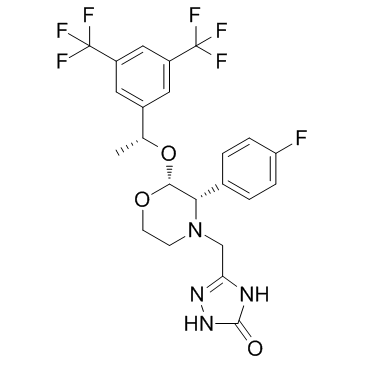
Aprepitant
CAS No. 170729-80-3
Aprepitant( MK-0869 | MK-869 | L-754030 )
Catalog No. M12607 CAS No. 170729-80-3
A potent, orally active, long-acting human NK-1 receptor (substance P receptor) antagonist with IC50 of 0.09 nM.
Purity : >98% (HPLC)
 COA
Datasheet
HNMR
HPLC
MSDS
Handing Instructions
COA
Datasheet
HNMR
HPLC
MSDS
Handing Instructions
| Size | Price / USD | Stock | Quantity |
| 5MG | 43 | In Stock |


|
| 10MG | 52 | In Stock |
|
| 50MG | 73 | In Stock |
|
| 100MG | 88 | In Stock |
|
| 200MG | 105 | In Stock |
|
| 500MG | 133 | In Stock |
|
| 1G | Get Quote | In Stock |
|
Biological Information
-
Product NameAprepitant
-
NoteResearch use only, not for human use.
-
Brief DescriptionA potent, orally active, long-acting human NK-1 receptor (substance P receptor) antagonist with IC50 of 0.09 nM.
-
DescriptionA potent, orally active, long-acting human NK-1 receptor (substance P receptor) antagonist with IC50 of 0.09 nM; blocks NK-1 agonist-induced foot tapping response in gerbils and shows antiemetic actions in the ferret against cisplatin challenge; has the potentiation for the treatment of peripheral pain, migraine, chemotherapy-induced emesis, and various psychiatric disorders.Chemotherapeutic Agents Approved(In Vitro):Aprepitant decreases the metabolic activity with an estimated IC50 value of 20 μM. Aprepitant induces cell-growth inhibition and G1 cell-cycle arrest. Aprepitant significantly induces apoptosis in Nalm-6 cells, and the apoptosis is mediated through caspase-3 activation. Aprepitant (20 μM) induces p53 accumulation and expression of pro-apoptotic p53 target genes. Aprepitant (1, 5, 10 μM) inhibits HIV infection in MDM from both depressed and not depressed HIV negative individuals ex vivo in a dose-dependent manner. IC90 value of aprepitant is equivalent to 10 μM, and the IC50 value is about 5 μM. (In Vivo):Aprepitant prevents the increase of NK-1R expression induced by in vivo NHP infection with B. burgdorferi. Aprepitant treatment prevents B. burgdorferi-induced increases in CCL2 protein levels in the CSF of NHPs. Aprepitant treatment prevents B. burgdorferi-induced increases in CCL2 and CXCL13 mRNA expression in the dorsal root ganglia of NHPs, prevents B. burgdorferi-induced increases in CCL2, CXCL13, IL-17A, and IL-6 mRNA expression in the spinal cord of NHPs. Aprepitant treatment attenuates B. burgdorferi infection-induced reductions in astrocyte activity/numbers. Aprepitant (10 mg/kg, i.p.) significantly attenuates the CPP expression and locomotor activation produced by AMPH and cocaine in mice. Aprepitant does not induce significant CPP or conditioned place aversion or locomotor activation or suppression. Aprepitant (125 mg/day, p.o.) results in 1 log reduction in plasma levels of viral RNA as compared to non-treated controls.
-
In VitroAprepitant decreases the metabolic activity with an estimated IC50 value of 20 μM. Aprepitant induces cell-growth inhibition and G1 cell-cycle arrest. Aprepitant significantly induces apoptosis in Nalm-6 cells, and the apoptosis is mediated through caspase-3 activation. Aprepitant (20 μM) induces p53 accumulation and expression of pro-apoptotic p53 target genes. Aprepitant (1, 5, 10 μM) inhibits HIV infection in MDM from both depressed and not depressed HIV negative individuals ex vivo in a dose-dependent manner. IC90 value of aprepitant is equivalent to 10 μM, and the IC50 value is about 5 μM.
-
In VivoAprepitant prevents the increase of NK-1R expression induced by in vivo NHP infection with B. burgdorferi. Aprepitant treatment prevents B. burgdorferi-induced increases in CCL2 protein levels in the CSF of NHPs. Aprepitant treatment prevents B. burgdorferi-induced increases in CCL2 and CXCL13 mRNA expression in the dorsal root ganglia of NHPs, prevents B. burgdorferi-induced increases in CCL2, CXCL13, IL-17A, and IL-6 mRNA expression in the spinal cord of NHPs. Aprepitant treatment attenuates B. burgdorferi infection-induced reductions in astrocyte activity/numbers. Aprepitant (10 mg/kg, i.p.) significantly attenuates the CPP expression and locomotor activation produced by AMPH and cocaine in mice. Aprepitant does not induce significant CPP or conditioned place aversion or locomotor activation or suppression. Aprepitant (125 mg/day, p.o.) results in 1 log reduction in plasma levels of viral RNA as compared to non-treated controls.
-
SynonymsMK-0869 | MK-869 | L-754030
-
PathwayGPCR/G Protein
-
TargetNeurokinin Receptor
-
RecptorNK1
-
Research AreaCancer
-
IndicationChemotherapeutic
Chemical Information
-
CAS Number170729-80-3
-
Formula Weight534.4266
-
Molecular FormulaC23H21F7N4O3
-
Purity>98% (HPLC)
-
Solubility10 mM in DMSO
-
SMILESO=C1NNC(CN2[C@@H](C3=CC=C(F)C=C3)[C@@H](O[C@@H](C4=CC(C(F)(F)F)=CC(C(F)(F)F)=C4)C)OCC2)=N1
-
Chemical Name3H-1,2,4-Triazol-3-one, 5-[[(2R,3S)-2-[(1R)-1-[3,5-bis(trifluoromethyl)phenyl]ethoxy]-3-(4-fluorophenyl)-4-morpholinyl]methyl]-1,2-dihydro-
Shipping & Storage Information
-
Storage(-20℃)
-
ShippingWith Ice Pack
-
Stability≥ 2 years
Reference
1. Kramer MS, et al. Science. 1998 Sep 11;281(5383):1640-5.
2. Hale JJ, et al. J Med Chem. 1998 Nov 5;41(23):4607-14.
3. Tattersall FD, et al. Neuropharmacology. 2000 Feb 14;39(4):652-63.
molnova catalog



related products
-
R 396
R 396 is a linear hexapeptide and is also an NK-2 tachykinin receptor antagonist.
-
L-732138
L-732138 is a potent and competitive antagonist of neurokinin-1 (NK-1) receptor(IC50 : 2.3 nM).
-
Fezolinetant
A potent, selective, orally active neurokinin-3 receptor (NK3R) antagonist with pIC50/pKi of 7.7/7.6.
