


 Cart
Cart
 sales@molnova.com



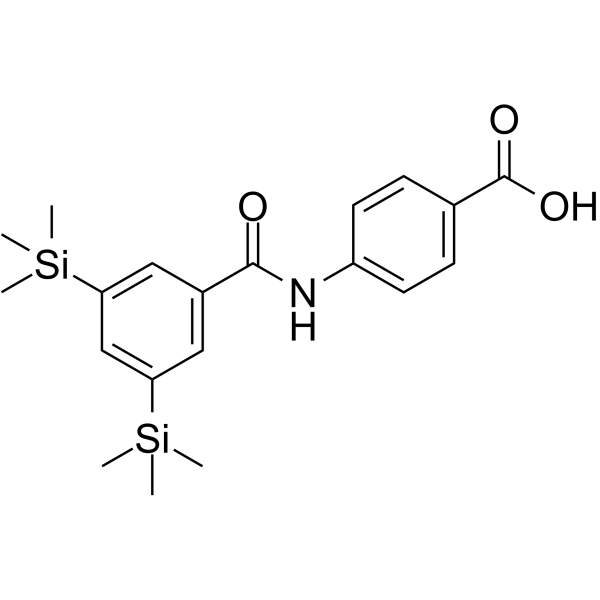
Amsilarotene
CAS No. 125973-56-0
Amsilarotene( TAC101 | TAC-101 | TAC 101 )
Catalog No. M27389 CAS No. 125973-56-0
Amsilarotene inhibits the phosphorylation of retinoblastoma gene product (RB) and increases the presence of 2 cyclin-dependent kinases (CDK) inhibitors resulting in cell cycle arrest.
Purity : >98% (HPLC)
 COA
Datasheet
HNMR
HPLC
MSDS
Handing Instructions
COA
Datasheet
HNMR
HPLC
MSDS
Handing Instructions
| Size | Price / USD | Stock | Quantity |
| 5MG | 132 | In Stock |


|
| 10MG | 215 | In Stock |
|
| 25MG | 430 | In Stock |
|
| 50MG | 620 | In Stock |
|
| 100MG | 884 | In Stock |
|
| 200MG | Get Quote | In Stock |
|
| 500MG | Get Quote | In Stock |
|
| 1G | Get Quote | In Stock |
|
Biological Information
-
Product NameAmsilarotene
-
NoteResearch use only, not for human use.
-
Brief DescriptionAmsilarotene inhibits the phosphorylation of retinoblastoma gene product (RB) and increases the presence of 2 cyclin-dependent kinases (CDK) inhibitors resulting in cell cycle arrest.
-
DescriptionAmsilarotene inhibits the phosphorylation of retinoblastoma gene product (RB) and increases the presence of 2 cyclin-dependent kinases (CDK) inhibitors resulting in cell cycle arrest. This agent also causes a cytotoxic decline in the thymidylate synthase and cyclin A expression.(In Vitro):Preclinical models have shown that Amsilarotene(4-[3,5-bis(trimethylsilyl) benzamide] benzoic acid), an oral synthetic retinoid, has antitumor activity in hepatocellular carcinoma (HCC).(In Vivo):We conducted a phase I study in Japanese patients with advanced HCC to examine the pharmacokinetics, recommended dose, safety, and efficacy of Amsilarotene. The administered dose of Amsilarotene was 10 mg/day in four patients (level 1), 20 mg/day in six (level 2), and 30 mg/day in three (level 3). There was no dose-limiting toxicity at level 1. Only one patient each had dose-limiting toxicity at level 2 (grade 2 fatigue, recovery requiring eight or more consecutive days of rest) and at level 3 (grade 3 splenic vein thrombosis). Level 3 (30 mg/day) was considered the maximum tolerated dose and 20 mg/day the recommended dose by a panel of medical experts, placing maximum emphasis on safety. The most frequent adverse events were fatigue, headache, and dermal symptoms such as rash. Pharmacokinetic parameters in Japanese patients with HCC were similar to those in patients in the United States, most of whom were Caucasian. Although no patient had a complete or partial response, the disease control rate was 38.5%. In conclusion, the recommended dose of Amsilarotene for patients with HCC is 20 mg/day. Amsilarotene had an acceptable toxicity profile, warranting further evaluation in clinical trials.
-
In VitroAmsilarotene (0, 10, 25 μM; 24 hours) induces apoptosis of human epithelial ovarian carcinoma-derived cell lines in a concentration-dependent manner.Amsilarotene (10, 20 μM; 0, 3, 6, and 9 days) inhibits the proliferation of BxPC-3 and MIAPaCa-2 cells.Amsilarotene (10 μM; 48 hours) increases the proportion of sensitive BxPC-3 cells in the G1 phase.Amsilarotene (10 μM; 0, 3, 6, 24, 48, 72 hours) inhibits the retinoblastoma-gene product (RB) phosphorylation in BxPC-3 cells between 24 and 72 hours. Apoptosis Analysis Cell Line:RMG-I, RMG-II, RTSG, RMUG-S, RMUG-L, and KF cells Concentration:0, 10, 25 μM Incubation Time:24 hours Result:Induced apoptosis in a concentration-dependent manner in all of the cell lines, except KF cells.Cell Proliferation Assay Cell Line:BxPC-3, MIAPaCa-2, AsPC-1 cells Concentration:10 and 20 μM Incubation Time:0, 3, 6, and 9 days.Result:Inhibited the proliferation of BxPC-3 and MIAPaCa-2 cells, but not the proliferation of AsPC-1 cells.Cell Cycle Analysis Cell Line:Sensitive BxPC-3 cells Concentration:10 μMIncubation Time:48 hoursResult:The proportion of cells in the G1 phase increased from 43% of untreated control cells to 86%
-
In VivoAmsilarotene (8 mg/kg/day orally for 30 days) inhibits the RMG-II tumor growth in nude mice. Animal Model:6-week-old female BALB/c nu/nu mice with subcutaneous RMG-II tumors Dosage:8 mg/kg/day Administration:Orally for 30 days Result:The maximal tumor growth-inhibiting effect was seen on day 31 of administration, when there was a 45% reduction of relative tumor volume (RTV).
-
SynonymsTAC101 | TAC-101 | TAC 101
-
PathwayAngiogenesis
-
TargetCDK
-
RecptorDNA/RNA Synthesis
-
Research Area——
-
Indication——
Chemical Information
-
CAS Number125973-56-0
-
Formula Weight385.61
-
Molecular FormulaC20H27NO3Si2
-
Purity>98% (HPLC)
-
SolubilityIn Vitro:?DMSO : 100 mg/mL (259.34 mM)
-
SMILESC[Si](C)(C)c1cc(cc(c1)[Si](C)(C)C)C(=O)Nc1ccc(cc1)C(O)=O
-
Chemical Name——
Shipping & Storage Information
-
Storage(-20℃)
-
ShippingWith Ice Pack
-
Stability≥ 2 years
Reference



-
Amt-87
Amt-87 is a HIV latency-reversal agent that reactivates latent HIV at the transcriptional level, promotes phosphorylation of CDK9 T-loop at Thr186.
-
CCT251545
CCT251545 is a potent, orally bioavailable inhibitor of Wnt signaling with IC50 of 5 nM, also is a potent and selective chemical probe for CDK8 and CDK19 with >100-fold selectivity over 291 other kinases; potently inhibits reporter-based readouts of basal WNT pathway activity in LS174T and SW480 cells in the absence of WNT ligand with IC50 of 23 and 190 nM, respectively.
-
Trilaciclib hydrochl...
Trilaciclib hydrochloride is an inhibitor of CDK4/6 (IC50s: 1 nM and 4 nM for CDK4 and CDK6).Incubation with Trilaciclib hydrochloride (G1T28) for 24 hours can induce a strong G1 cell cycle arrest (time=0). Cells have re-entered the cell cycle and demonstrate cell-cycle kinetics similar to untreated control cells By 16 hours after Trilaciclib hydrochloride washout.
