


 Cart
Cart
 sales@molnova.com



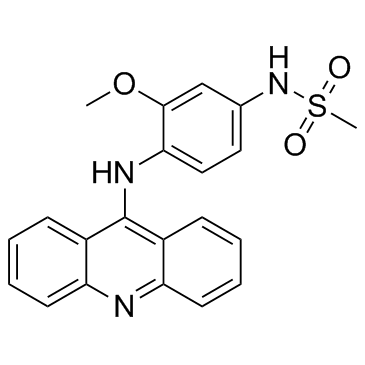
Amsacrine
CAS No. 51264-14-3
Amsacrine( —— )
Catalog No. M14772 CAS No. 51264-14-3
Amsacrine (mAMSA) an antineoplastic agent which can intercalate into the DNA of tumor cells.
Purity : >98% (HPLC)
 COA
Datasheet
HNMR
HPLC
MSDS
Handing Instructions
COA
Datasheet
HNMR
HPLC
MSDS
Handing Instructions
| Size | Price / USD | Stock | Quantity |
| 10MG | 35 | In Stock |


|
| 25MG | 52 | In Stock |
|
| 100MG | Get Quote | In Stock |
|
| 200MG | Get Quote | In Stock |
|
| 500MG | Get Quote | In Stock |
|
| 1G | Get Quote | In Stock |
|
Biological Information
-
Product NameAmsacrine
-
NoteResearch use only, not for human use.
-
Brief DescriptionAmsacrine (mAMSA) an antineoplastic agent which can intercalate into the DNA of tumor cells.
-
DescriptionAmsacrine (mAMSA) an antineoplastic agent which can intercalate into the DNA of tumor cells. Amsacrine also expresses topoisomerase inhibitor activity, specifically inhibiting topoisomerase II.(In Vitro):Amsacrine (m-AMSA) blocks HERG currents in HEK 293 cells and Xenopus oocytes in a concentration-dependent manner, with IC50 values of 209.4 nm and 2.0 μM, respectively. Amsacrine (m-AMSA) causes a negative shift in the voltage dependence of both activation (?7.6 mV) and inactivation (?7.6 mV). HERG current block by amsacrine is not frequency dependent. In vitro studies of normal human lymphocytes with various concentrations of Amsacrine (m-AMSA), show both increased levels of chromosomal aberrations, ranging from 8% to 100%, and increase SCEs, ranging from 1.5 times the normal at the lowest concentration studied (0.005 μg/mL) to 12 times the normal (0.25 μg/mL). Amsacrine (m-AMSA)-induced apoptosis of U937 cells is characterized by caspase-9 and caspase-3 activation, increased intracellular Ca2+ concentration, mitochondrial depolarization, and MCL1 down-regulation. Amsacrine (m-AMSA) induces MCL1 down-regulation by decreasing its stability. Further, amsacrine-treated U937 cells show AKT degradation and Ca2+-mediated ERK inactivation. (In Vivo):In animals treated with different doses of amsacrine (0.5-12 mg/kg), the frequencies of micronucleated polychromatic erythrocytes increase significantly after treatment with 9 and 12 mg/kg. Furthermore, the present study demonstrates for the first time that Amsacrine (m-AMSA) has high incidences of clastogenicity and low incidences of aneugenicity whereas nocodazole has high incidences of aneugenicity and low incidences of clastogenicity during mitotic phases in vivo.
-
In VitroAmsacrine (m-AMSA) blocks HERG currents in HEK 293 cells and Xenopus oocytes in a concentration-dependent manner, with IC50 values of 209.4 nm and 2.0 μM, respectively. Amsacrine (m-AMSA) causes a negative shift in the voltage dependence of both activation (?7.6 mV) and inactivation (?7.6 mV). HERG current block by amsacrine is not frequency dependent. In vitro studies of normal human lymphocytes with various concentrations of Amsacrine (m-AMSA), show both increased levels of chromosomal aberrations, ranging from 8% to 100%, and increase SCEs, ranging from 1.5 times the normal at the lowest concentration studied (0.005 μg/mL) to 12 times the normal (0.25 μg/mL). Amsacrine (m-AMSA)-induced apoptosis of U937 cells is characterized by caspase-9 and caspase-3 activation, increased intracellular Ca2+ concentration, mitochondrial depolarization, and MCL1 down-regulation. Amsacrine (m-AMSA) induces MCL1 down-regulation by decreasing its stability. Further, amsacrine-treated U937 cells show AKT degradation and Ca2+-mediated ERK inactivation.
-
In VivoIn animals treated with different doses of amsacrine (0.5-12 mg/kg), the frequencies of micronucleated polychromatic erythrocytes increase significantly after treatment with 9 and 12 mg/kg. Furthermore, the present study demonstrates for the first time that Amsacrine (m-AMSA) has high incidences of clastogenicity and low incidences of aneugenicity whereas nocodazole has high incidences of aneugenicity and low incidences of clastogenicity during mitotic phases in vivo.
-
Synonyms——
-
PathwayCell Cycle/DNA Damage
-
TargetPotassium Channel
-
RecptorPotassium Channel| Topo II
-
Research AreaCancer
-
Indication——
Chemical Information
-
CAS Number51264-14-3
-
Formula Weight393.46
-
Molecular FormulaC21H19N3O3S
-
Purity>98% (HPLC)
-
SolubilityDMSO: 9.3 mg/mL
-
SMILESCOC1=C(NC2=C3C=CC=CC3=NC3=CC=CC=C23)C=CC(NS(C)(=O)=O)=C1
-
Chemical Name——
Shipping & Storage Information
-
Storage(-20℃)
-
ShippingWith Ice Pack
-
Stability≥ 2 years
Reference
1.Thomas D, et al. Br J Pharmacol. 2004 Jun;142(3):485-94.
molnova catalog



related products
-
Tolazamide
Tolazamide is an oral blood glucose lowering drug used for people with Type 2 diabetes.
-
Doxapram hydrochlori...
Doxapram hydrochloride hydrate inhibits TASK-1, TASK-3, TASK-1/TASK-3 heterodimeric channel function with EC50 of 410 nM, 37 μM, 9 μM, respectively.
-
Azimilide dihydrochl...
A class ΙΙΙ antiarrhythmic agent that blocks hERG channel; blocks HERG channel at 0.1 and 1 Hz with IC50s of 1.4 uM and 5.2 uM respectively.
