


 Cart
Cart
 sales@molnova.com



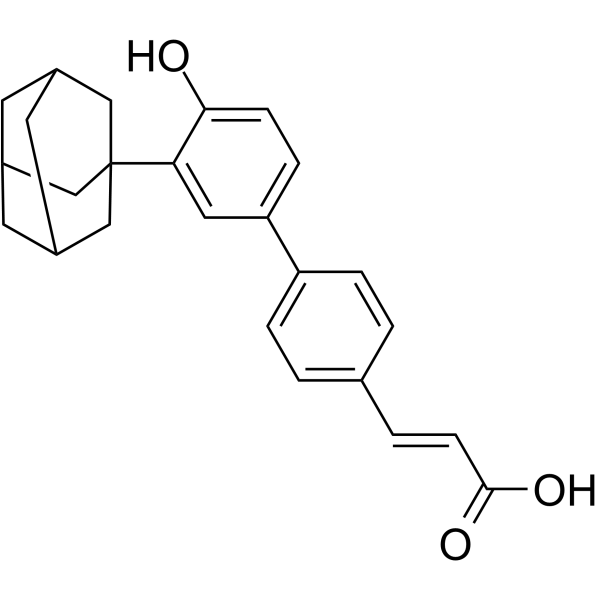
Adarotene
CAS No. 496868-77-0
Adarotene( ST1926 )
Catalog No. M26599 CAS No. 496868-77-0
Adarotene is an effective apoptosis inducer. It surprisingly produces DNA damage and exhibits a potent antiproliferative activity on a large panel of human tumor cells.
Purity : >98% (HPLC)
 COA
Datasheet
HNMR
HPLC
MSDS
Handing Instructions
COA
Datasheet
HNMR
HPLC
MSDS
Handing Instructions
| Size | Price / USD | Stock | Quantity |
| 2MG | 41 | Get Quote |


|
| 5MG | 67 | Get Quote |
|
| 10MG | 120 | Get Quote |
|
| 25MG | 230 | Get Quote |
|
| 50MG | 370 | Get Quote |
|
| 100MG | 537 | Get Quote |
|
| 500MG | 1152 | Get Quote |
|
| 1G | Get Quote | Get Quote |
|
Biological Information
-
Product NameAdarotene
-
NoteResearch use only, not for human use.
-
Brief DescriptionAdarotene is an effective apoptosis inducer. It surprisingly produces DNA damage and exhibits a potent antiproliferative activity on a large panel of human tumor cells.
-
DescriptionAdarotene is an effective apoptosis inducer. It surprisingly produces DNA damage and exhibits a potent antiproliferative activity on a large panel of human tumor cells.(In Vitro):Adarotene causes cell accumulation in the G1/S or S phase of the cell cycle depending on tumor cells IGROV-1 and DU145. Adarotene causes dose-dependent growth inhibition in a large panel of human tumor cell lines with IC50 ranging from 0.1 to 0.3 μM . Adarotene is apoptotic and cytotoxic on a large spectrum of cancerous and leukemic cells, including freshly isolated AML blasts in primary culture. Adarotene treatment of cells results in rapid accumulation of intracellular calcium .(In Vivo):Adarotene (30, 40 mg/kg, p.o.) results in a significant and dose-dependent increase in the life span of NB4-bearing SCID mice without overt toxicity . Adarotene (15, 20 mg/kg, p.o.) causes a significant tumor growth inhibition in a human ovarian carcinoma, A2780/DX, and in human melanoma, MeWo, growing in nude mice .
-
In VitroAdarotene causes a dose-dependent growth inhibition in a large panel of human tumor cell lines with IC50 ranging from 0.1 to 0.3 μM. Adarotene causes cell accumulation in G1/S or S phase of cell cycle depending on tumor cells IGROV-1 and DU145. Adarotene is apoptotic and cytotoxic on a large spectrum of cancerous and leukemic cells, including freshly isolated AML blasts in primary culture. The molecular target of ST1926 apoptotic activity in myeloid leukemia cells is similar to the ligand-binding domain of RARγ. Adarotene treatment of cells results in rapid accumulation of intracellular calcium.
-
In VivoAdarotene (15, 20 mg/kg, p.o.) causes a significant tumor growth inhibition in a human ovarian carcinoma, A2780/DX, and in a human melanoma, MeWo, growing in nude mice. Adarotene (30, 40 mg/kg, p.o.) results in a significant and dose-dependent increase in the life span of NB4-bearing SCID mice without overt toxicity.
-
SynonymsST1926
-
PathwayApoptosis
-
TargetApoptosis
-
RecptorAntibiotic| Bacterial| Fungal| Parasite| Phosphatase
-
Research Area——
-
Indication——
Chemical Information
-
CAS Number496868-77-0
-
Formula Weight374.48
-
Molecular FormulaC25H26O3
-
Purity>98% (HPLC)
-
SolubilityIn Vitro:?DMSO : 25 mg/mL (66.76 mM)
-
SMILESOC(=O)\C=C\c1ccc(cc1)-c1ccc(O)c(c1)C12CC3CC(CC(C3)C1)C2
-
Chemical Name——
Shipping & Storage Information
-
Storage(-20℃)
-
ShippingWith Ice Pack
-
Stability≥ 2 years
Reference
1.Nguewa, P.A., et al., Pentamidine is an antiparasitic and apoptotic drug that selectively modifies ubiquitin. Chem Biodivers, 2005. 2(10): p. 1387-400.
molnova catalog



related products
-
CGP 3466B maleate
Omigapil maleate is an orally bioavailable GAPDH nitrosylation inhibitor. Omigapil maleate abrogates Aβ1-42-induced tau acetylation, memory impairment, and locomotor dysfunction in mice.
-
3'-Hydroxypterostilb...
3'-Hydroxypterostilbene a natural pterostilbene analogue effectively inhibits the growth of human colon cancer cells with IC50s of 9.0 40.2 and 70.9 μM for COLO 205 HCT-116 and HT-29 cells respectively by inducing apoptosis and autophagy.
-
RIPK3-IN-1
RIPK3-IN-1 is a selective and potent RIPK3 inhibitor (IC50: 9.1 nM) that inhibits the activities of c-Met kinase, RIPK1 and RIPK2.RIPK3-IN-1 has potential tumorigenic activity and can be used to study apoptosis.
