


 Cart
Cart
 sales@molnova.com



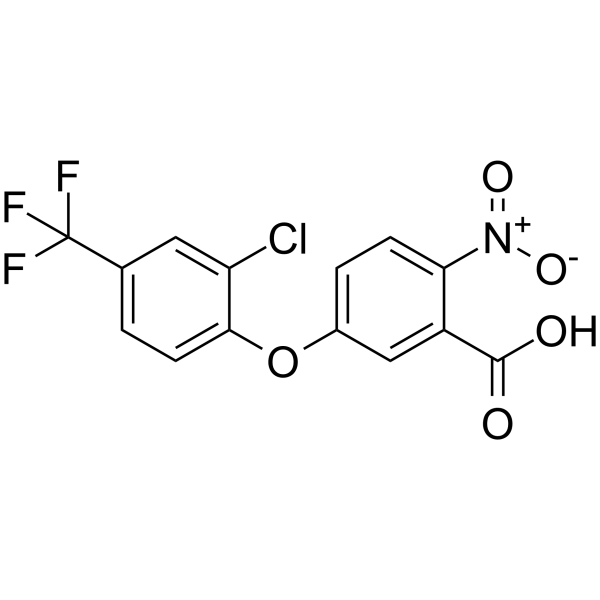
Acifluorfen
CAS No. 50594-66-6
Acifluorfen( —— )
Catalog No. M28315 CAS No. 50594-66-6
Acifluorfen, a protoporphyrinogen oxidase (PROTOX) inhibitor herbicide, promotes the accumulation of protoporphyrin IX (PPIX), and induces tumors in the rodent liver. Acifluorfen causes strong photooxidative destruction of pigments and lipids in sensitive plant species.
Purity : >98% (HPLC)
 COA
Datasheet
HNMR
HPLC
MSDS
Handing Instructions
COA
Datasheet
HNMR
HPLC
MSDS
Handing Instructions
| Size | Price / USD | Stock | Quantity |
| 50MG | 37 | Get Quote |


|
| 100MG | 55 | Get Quote |
|
| 200MG | 80 | Get Quote |
|
| 500MG | Get Quote | Get Quote |
|
| 1G | Get Quote | Get Quote |
|
Biological Information
-
Product NameAcifluorfen
-
NoteResearch use only, not for human use.
-
Brief DescriptionAcifluorfen, a protoporphyrinogen oxidase (PROTOX) inhibitor herbicide, promotes the accumulation of protoporphyrin IX (PPIX), and induces tumors in the rodent liver. Acifluorfen causes strong photooxidative destruction of pigments and lipids in sensitive plant species.
-
DescriptionAcifluorfen, a protoporphyrinogen oxidase (PROTOX) inhibitor herbicide, promotes the accumulation of protoporphyrin IX (PPIX), and induces tumors in the rodent liver. Acifluorfen causes strong photooxidative destruction of pigments and lipids in sensitive plant species.(In Vitro):The effect of Acifluorfen on glutathione and ascorbate levels in cucumber (Cucumis sativus L.) cotyledon discs is investigated to assess the relationship between herbicide activity and endogenous antioxidants. Acifluorfen decreases the levels of glutathione and ascorbate over 50% in discs exposed to less than 1.5 hours of white light (450 microeinsteins per square meter per second). Acifluorfen also causes the rapid depletion of ascorbate in far-red light grown plants which are photosynthetically incompetent. (In Vivo):Dietary treatment with 2500 ppm Acifluorfen for up to 13 weeks increases Cyp2b10 expression in the livers of wild-type mice, but not in CAR-knockout (CARKO) mice. Microscopically, Acifluorfen treatment-induces cytotoxic changes, including hepatocellular necrosis and inflammation, and causes regenerative changes accompanied by prolonged increases in the numbers of proliferating cell nuclear antigen-positive hepatocytes in WT mice .
-
In VitroThe effect of Acifluorfen on glutathione and ascorbate levels in cucumber (Cucumis sativus L.) cotyledon discs is investigated to assess the relationship between herbicide activity and endogenous antioxidants. Acifluorfen decreases the levels of glutathione and ascorbate over 50% in discs exposed to less than 1.5 hours of white light (450 microeinsteins per square meter per second). Acifluorfen also causes the rapid depletion of ascorbate in far-red light grown plants which are photosynthetically incompetent.
-
In Vivo——
-
Synonyms——
-
PathwayOthers
-
TargetOther Targets
-
RecptorDyrk1A|Dyrk1B
-
Research Area——
-
Indication——
Chemical Information
-
CAS Number50594-66-6
-
Formula Weight361.66
-
Molecular FormulaC14H7ClF3NO5
-
Purity>98% (HPLC)
-
SolubilityIn Vitro:?DMSO : 25 mg/mL (69.13 mM)
-
SMILESOC(=O)c1cc(Oc2ccc(cc2Cl)C(F)(F)F)ccc1[N+]([O-])=O
-
Chemical Name——
Shipping & Storage Information
-
Storage(-20℃)
-
ShippingWith Ice Pack
-
Stability≥ 2 years
Reference
1.Ogawa Y, et al. Development of a novel selective inhibitor of the Down syndrome-related kinase Dyrk1A. Nat Commun. 2010 Oct 5;1:86.
molnova catalog



related products
-
Transglutaminase
Transglutaminase (TG) is a thiolase that induces intermolecular cross-linking of proteins, by catalysing the formation of isopeptide bonds between the γ-carboxamide group of glutamine residues and the primary ε-amine group of other compounds.
-
Padsevonil
Padsevonil (UCB-0942, UCB0942) is a potential anti-seizure agent that functions as a pre- and post-synaptic inhibitor.
-
Methyl 5,6-dibromo-1...
Methyl 5,6-dibromo-1H-indole-3-carboxylate is a marine derived natural products found in Smenospongia sp.
