


 Cart
Cart
 sales@molnova.com



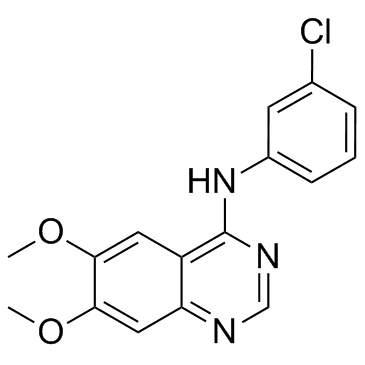
AG-1478
CAS No. 153436-53-4
AG-1478( NSC 693255 | Tyrphostin AG-1478 )
Catalog No. M12161 CAS No. 153436-53-4
AG-1478 (Tyrphostin AG-1478) is a selective EGFR inhibitor with IC50 of 3 nM in cell-free assays, almost no activity on HER2-Neu, PDGFR, Trk, Bcr-Abl and InsR.
Purity : >98% (HPLC)
 COA
Datasheet
HNMR
HPLC
MSDS
Handing Instructions
COA
Datasheet
HNMR
HPLC
MSDS
Handing Instructions
| Size | Price / USD | Stock | Quantity |
| 5MG | 41 | In Stock |


|
| 10MG | 55 | In Stock |
|
| 25MG | 103 | In Stock |
|
| 50MG | 186 | In Stock |
|
| 100MG | 259 | In Stock |
|
| 200MG | 337 | In Stock |
|
| 500MG | Get Quote | In Stock |
|
| 1G | Get Quote | In Stock |
|
Biological Information
-
Product NameAG-1478
-
NoteResearch use only, not for human use.
-
Brief DescriptionAG-1478 (Tyrphostin AG-1478) is a selective EGFR inhibitor with IC50 of 3 nM in cell-free assays, almost no activity on HER2-Neu, PDGFR, Trk, Bcr-Abl and InsR.
-
DescriptionAG-1478 (Tyrphostin AG-1478) is a selective EGFR inhibitor with IC50 of 3 nM in cell-free assays, almost no activity on HER2-Neu, PDGFR, Trk, Bcr-Abl and InsR.
-
In VitroAG-1478 (AG1478) is irreversible for growth regulation of human lung (A549) and prostate (DU145) cancer cell lines, cultured in chemically defined DMEM/F12 medium. AG-1478 seems to be more effective at lower concentrations, but is unable to completely inhibit growth of A549 cells. Inhibition of EGFR by specific tyrosine kinase inhibitor AG-1478 (AG1478) significantly decreases the angiotensin II-mediated synthesis of TGF-β and fibronectin by cardiac fibroblasts. EGFR is pharmacologically inhibited by small-molecule inhibitor AG-1478 with IC50 of 4 nM. Both Polyfect (PF) and Superfect (SF) treatment lead to increased apoptosis in HEK 293 cells to a similar extent as assessed by flow cytometry. The antioxidant, tempol, significantly reduced dendrimer-mediated apoptosis for both PF and SF. AG-1478 (AG1478), at a 10-fold higher dose (100 μM) than used in signaling studies, is used as a positive control and significantly induced apoptosis in HEK 293 cells.
-
In VivoAdministration of AG-1478 (AG1478) significantly reduces myocardial inflammation, fibrosis, apoptosis, and dysfunction in both two obese mouse models. ApoE-/- mice are first fed with HFD for 8 weeks (ApoE-HFD), and then administrated with AG-1478 (10 mg/kg/day) or 542 (10 mg/kg/day) for another 8 weeks by oral gavage. AG-1478 or 542 treatment blocks HFD induced cardiac EGFR phosphorylation in vivo, without affecting the plasma level of low density lipoprotein (LDL) and total triglyceride (TG). Administration of EGF (10 nM) leads to a robust and reproducible elevation in EGFR phosphorylation that can be blocked by AG-1478 (AG1478), a known inhibitor of EGFR phosphorylation. Increasing doses of Polyfect (PF) result in a significant reduction in EGF-induced EGFR phosphorylation (p<0.05) but this is to a lesser extent than observed with AG1478.
-
SynonymsNSC 693255 | Tyrphostin AG-1478
-
PathwayAngiogenesis
-
TargetEGFR
-
RecptorEGFR| HER2| PDGFR
-
Research AreaCancer
-
Indication——
Chemical Information
-
CAS Number153436-53-4
-
Formula Weight315.75
-
Molecular FormulaC16H14ClN3O2
-
Purity>98% (HPLC)
-
SolubilityEthanol: 13 mg/mL (41.17 mM); DMSO: 25 mg/mL (79.17 mM)
-
SMILESCOC1=CC2=NC=NC(NC3=CC=CC(Cl)=C3)=C2C=C1OC
-
Chemical NameN-(3-chlorophenyl)-6,7-dimethoxyquinazolin-4-amine
Shipping & Storage Information
-
Storage(-20℃)
-
ShippingWith Ice Pack
-
Stability≥ 2 years
Reference
1.Levitzki A, et al. Science, 1995, 267(5205), 1782-1788.
molnova catalog



related products
-
PD 174265
PD 174265 is an effective, selective and reversible inhibitor of epidermal growth factor receptor (EGFR) with an IC50 of 0.45 nM.
-
Lapatinib
A reversible, selective dual tyrosine kinase inhibitor of both EGFR and ErbB2 with IC50 of 10.8 and 9.2 nM in cell-free assays, respectively.
-
Matuzumab
Matuzumab is a humanized monoclonal antibody used in cancer treatment. It has a high affinity for EGFR frequently associated with the growth of blood vessels in malignancy facilitating tumor growth and survival.
