


 Cart
Cart
 sales@molnova.com



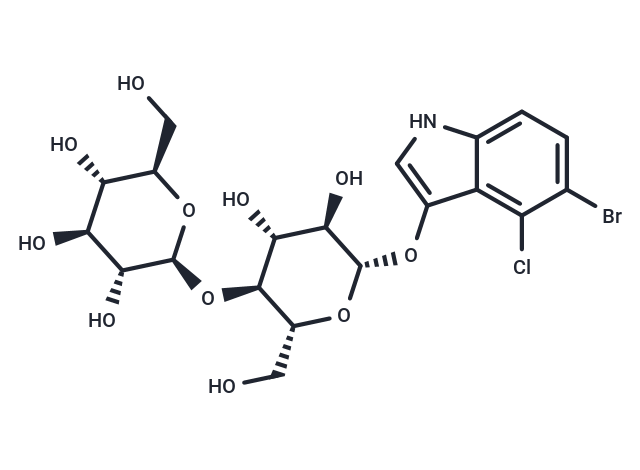
5-Bromo-4-chloro-3-indoxyl-beta-D-cellobioside
CAS No. 177966-52-8
5-Bromo-4-chloro-3-indoxyl-beta-D-cellobioside( —— )
Catalog No. M35305 CAS No. 177966-52-8
5-Bromo-4-chloro-3-indoxyl-beta-D-cellobioside is a chromogenic compound used to detect cellobiohydrolases.
Purity : >98% (HPLC)
 COA
Datasheet
HNMR
HPLC
MSDS
Handing Instructions
COA
Datasheet
HNMR
HPLC
MSDS
Handing Instructions
| Size | Price / USD | Stock | Quantity |
| 5MG | 29 | Get Quote |


|
| 10MG | 43 | Get Quote |
|
| 25MG | 71 | Get Quote |
|
| 50MG | 106 | Get Quote |
|
| 100MG | 155 | Get Quote |
|
| 200MG | 233 | Get Quote |
|
| 500MG | Get Quote | Get Quote |
|
| 1G | Get Quote | Get Quote |
|
Biological Information
-
Product Name5-Bromo-4-chloro-3-indoxyl-beta-D-cellobioside
-
NoteResearch use only, not for human use.
-
Brief Description5-Bromo-4-chloro-3-indoxyl-beta-D-cellobioside is a chromogenic compound used to detect cellobiohydrolases.
-
Description5-Bromo-4-chloro-3-indolyl β-D-cellobioside is a chromogenic compound used to detect cellobiohydrolases.
-
In Vitro——
-
In Vivo——
-
Synonyms——
-
PathwayOthers
-
TargetOther Targets
-
RecptorOthers
-
Research Area——
-
Indication——
Chemical Information
-
CAS Number177966-52-8
-
Formula Weight570.77
-
Molecular FormulaC20H25BrClNO11
-
Purity>98% (HPLC)
-
Solubility——
-
SMILESO(C=1C=2C(NC1)=CC=C(Br)C2Cl)[C@@H]3O[C@H](CO)[C@@H](O[C@@H]4O[C@H](CO)[C@@H](O)[C@H](O)[C@H]4O)[C@H](O)[C@H]3O
-
Chemical Name——
Shipping & Storage Information
-
Storage(-20℃)
-
ShippingWith Ice Pack
-
Stability≥ 2 years
Reference
1. Cortes-Tolalpa L, et al. Halotolerant microbial consortia able to degrade highly recalcitrant plant biomass substrate. Appl Microbiol Biotechnol. 2018 Mar;102(6):2913-2927.?
molnova catalog



related products
-
Perfluorooctanoic ac...
Perfluorooctanoic acid (PFOA) is a persistent and widespread industry-made chemical.
-
Propargyl-C1-NHS est...
Propargyl-C1-NHS ester is a nonclaevable linker for antibody-drug-conjugation (ADC).
-
Lupeol palmitate
Lupeol palmitate is a naturally occurring compound that can be extracted from Ligularia songarica and has antiulcer activity and gastrointestinal protection.
