


 Cart
Cart
 sales@molnova.com



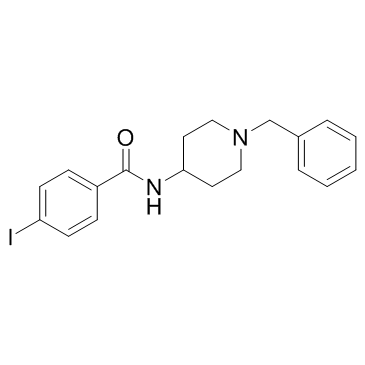
4-IBP
CAS No. 155798-08-6
4-IBP( —— )
Catalog No. M18082 CAS No. 155798-08-6
4-IBP is a selective σ1 agonist with a high level of affinity for the σ1 receptor (Ki = 1.7 nM) and a moderate affinity for the σ2 receptor (Ki = 25.2 nM) .
Purity : >98% (HPLC)
 COA
Datasheet
HNMR
HPLC
MSDS
Handing Instructions
COA
Datasheet
HNMR
HPLC
MSDS
Handing Instructions
| Size | Price / USD | Stock | Quantity |
| 2MG | 37 | In Stock |


|
| 5MG | 58 | In Stock |
|
| 10MG | 83 | In Stock |
|
| 25MG | 176 | In Stock |
|
| 50MG | 344 | In Stock |
|
| 100MG | 511 | In Stock |
|
| 200MG | 734 | In Stock |
|
| 500MG | Get Quote | In Stock |
|
| 1G | Get Quote | In Stock |
|
Biological Information
-
Product Name4-IBP
-
NoteResearch use only, not for human use.
-
Brief Description4-IBP is a selective σ1 agonist with a high level of affinity for the σ1 receptor (Ki = 1.7 nM) and a moderate affinity for the σ2 receptor (Ki = 25.2 nM) .
-
Description4-IBP is a selective σ1 agonist with a high level of affinity for the σ1 receptor (Ki = 1.7 nM) and a moderate affinity for the σ2 receptor (Ki = 25.2 nM) .
-
In Vitro——
-
In Vivo——
-
Synonyms——
-
PathwayOthers
-
TargetOther Targets
-
Recptorσ1|σ2
-
Research AreaCancer
-
Indication——
Chemical Information
-
CAS Number155798-08-6
-
Formula Weight420.29
-
Molecular FormulaC19H21IN2O
-
Purity>98% (HPLC)
-
SolubilityDMSO : 20 mg/mL 47.59 mM;H2O : < 0.1 mg/mL
-
SMILESIc1ccc(cc1)C(=O)NC3CCN(Cc2ccccc2)CC3
-
Chemical Name——
Shipping & Storage Information
-
Storage(-20℃)
-
ShippingWith Ice Pack
-
Stability≥ 2 years
Reference
molnova catalog



related products
-
Sumaresinolic Acid
Sumaresinolic Acid is a chemical compound.
-
Tryptamine hydrochlo...
Tryptamine hydrochloride is a useful organic compound for research related to life sciences.
-
Ladanein
Ladanein is a phytochemicals inhibitor that is known to disrupt the interactions of core and other hepatitis C virus (HCV) proteins.Ladanein possesses free radicals DPPH and ABTS +.scavenging activity, it also displays moderate (20-40 microM) activities against K562, K562R (imatinib-resistant), and 697 human leukemia cell lines.
