


 Cart
Cart
 sales@molnova.com



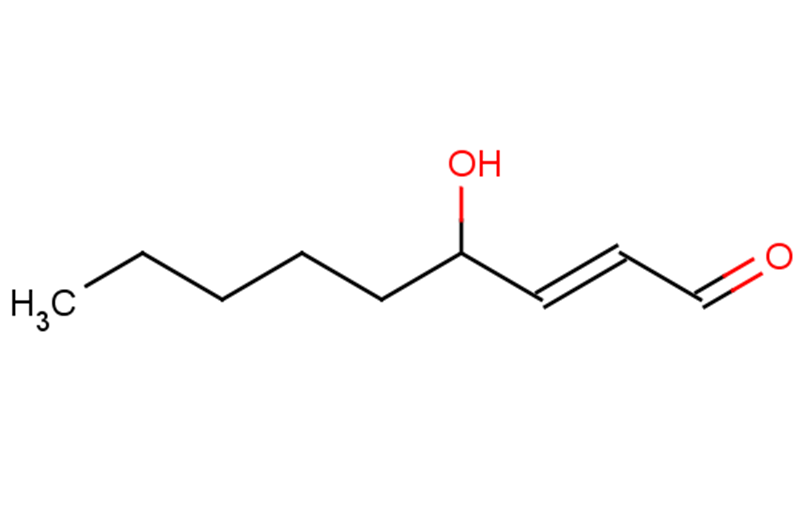
4-Hydroxynonenal
CAS No. 75899-68-2
4-Hydroxynonenal( 4-HNE )
Catalog No. M22673 CAS No. 75899-68-2
4-Hydroxynonenal (4-HNE) is an oxidative/nitrosative stress biomarker. It is a substrate and an inhibitor of acetaldehyde dehydrogenase 2 (ALDH2).
Purity : >98% (HPLC)
 COA
Datasheet
HNMR
HPLC
MSDS
Handing Instructions
COA
Datasheet
HNMR
HPLC
MSDS
Handing Instructions
| Size | Price / USD | Stock | Quantity |
| 5MG | 88 | In Stock |


|
| 10MG | 154 | In Stock |
|
| 25MG | 291 | In Stock |
|
| 50MG | 470 | In Stock |
|
| 100MG | 680 | In Stock |
|
| 200MG | Get Quote | In Stock |
|
| 500MG | Get Quote | In Stock |
|
| 1G | Get Quote | In Stock |
|
Biological Information
-
Product Name4-Hydroxynonenal
-
NoteResearch use only, not for human use.
-
Brief Description4-Hydroxynonenal (4-HNE) is an oxidative/nitrosative stress biomarker. It is a substrate and an inhibitor of acetaldehyde dehydrogenase 2 (ALDH2).
-
Description4-Hydroxynonenal (4-HNE) is an oxidative/nitrosative stress biomarker. It is a substrate and an inhibitor of acetaldehyde dehydrogenase 2 (ALDH2).4-Hydroxynonenal is both a substrate and an inhibitor of ALDH2; inhibition of ALDH2 by 4-Hydroxynonenal is reversible at low concentration and becomes irreversible when the concentration of 4-HNE reaches 10 μM. 4-Hydroxynonenal can induce antioxidant defense mechanisms to restrain its own production and to enhance cellular protection against oxidative stress. 4-Hydroxynonenal, the product of lipid peroxidation, is mutagenic and genotoxic in viruses, bacteria, and mammalian cells. It reacts with all four DNA bases but with different efficiency: G >C > A >T. 4-Hydroxynonenal-dG represents the best biomarker of the genotoxic effects of 4-Hydroxynonenal and these adducts are primarily found in nuclear DNA [1].Following 24 h after fluid percussion injury (FPI), the mouse brain tissue is analyzed for the expression level of NADPH oxidase 1 (NOX1), inducible nitric oxide synthase (iNOS), 4-Hydroxynonenal (4-HNE. Both wild-type (Nrf2+/+) and Nrf2-deficient mice (Nrf2 / ) results in increased expression of 4-Hydroxynonenal following 15 psi injury (moderate injury) when compared to uninjured Nrf2+/+ and Nrf2 / mice. Similar to the iNOS result, in Nrf2 / KO mice, the expression level of 4-Hydroxynonenal is significantly high when compared to corresponding injured and uninjured Nrf2+/+ WT animals.
-
In Vitro4-Hydroxynonenal is both a substrate and an inhibitor of ALDH2; inhibition of ALDH2 by 4-Hydroxynonenal is reversible at low concentration and become irreversible when the concentration of 4-HNE reaches 10 μM.4-Hydroxynonenal can induce antioxidant defense mechanisms to restrain its own production and to enhance the cellular protection against oxidative stress.4-Hydroxynonenal, the product of lipid peroxidation, is mutagenic and genotoxic in viruses, bacteria and mammalian cells. It reacts with all four DNA bases but with different efficiency: G >C > A >T. 4-Hydroxynonenal-dG represents the best biomarker of the genotoxic effects of 4-Hydroxynonenal and these adducts are primarily found in nuclear DNA. A classic example of etiological relevance of 4-Hydroxynonenal-dG in human cancers is 4-Hydroxynonenal-dG induced p53 mutation. 4-Hydroxynonenal-dG adducts were preferentially formed at the third base of codon 249 in the p53 gene, causing gene mutation and affecting diverse biological processes including cell cycle arrest, apoptosis, DNA repair, and differentiation.
-
In VivoFollowing 24 h after fluid percussion injury (FPI), the mouse brain tissue is analyzed for the expression level of NADPH oxidase 1 (NOX1), inducible nitric oxide synthase (iNOS), 4-Hydroxynonenal (4-HNE. Both wild-type (Nrf2+/+) and Nrf2-deficient mice (Nrf2-/-) results in increased expression of 4-Hydroxynonenal following 15 psi injury (moderate injury) when compared to uninjured Nrf2+/+ and Nrf2-/- mice. Similar to iNOS result, in Nrf2-/- KO mice, the expression level of 4-Hydroxynonenal is significantly high when compared to corresponding injured and uninjured Nrf2+/+ WT animals.
-
Synonyms4-HNE
-
PathwayProteasome/Ubiquitin
-
TargetEndogenous Metabolite
-
RecptorHuman Endogenous Metabolite|ALDH2
-
Research Area——
-
Indication——
Chemical Information
-
CAS Number75899-68-2
-
Formula Weight156.22
-
Molecular FormulaC9H16O2
-
Purity>98% (HPLC)
-
SolubilityDMSO:249 mg/mL(1593.91 mM)
-
SMILESCCCCCC(O)\C=C\C=O
-
Chemical Name——
Shipping & Storage Information
-
Storage(-20℃)
-
ShippingWith Ice Pack
-
Stability≥ 2 years
Reference
1. Zhong H, et al. Role of lipid peroxidation derived 4-hydroxynonenal (4-HNE) in cancer: focusing on mitochondria. Redox Biol. 2015;4:193-9.
molnova catalog



related products
-
Nervonic acid
Nervonic acid is a long chain unsaturated fatty acid that is enriched in sphingomyelin. It consists of choline sphingosine phosphoric acid and fatty acid.
-
3-Indoleacrylic acid
3-Indoleacrylic acid is a metabolite of tryptophan produced by Peptostreptococcus species. 3-Indoleacrylic acid has a beneficial effect on intestinal epithelial barrier function and mitigates inflammatory responses by immune cells.
-
3-Hydroxyanthranilic...
3-Hydroxyanthranilic acid also known as 2-amino-3-hydroxy-benzoate or 3-ohaa belongs to the class of organic compounds known as hydroxybenzoic acid derivatives. 3-Hydroxyanthranilic acid has been found in human epidermis and bladder tissues and has also been detected in multiple biofluids such as urine and blood.
