


 Cart
Cart
 sales@molnova.com



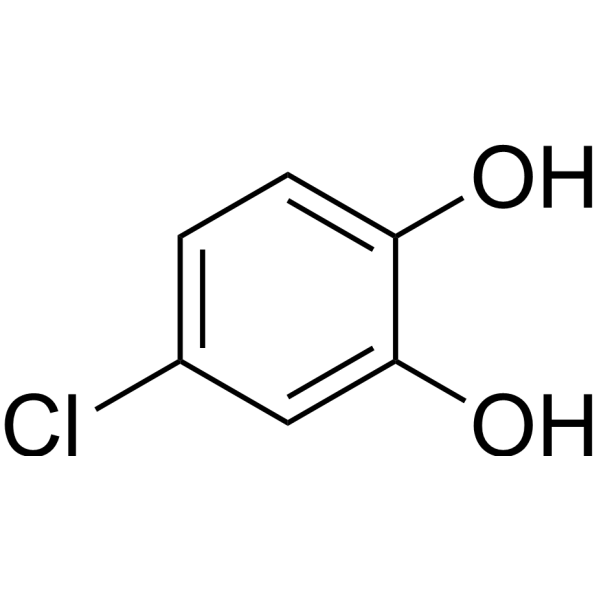
4-Chlorocatechol
CAS No. 2138-22-9
4-Chlorocatechol( —— )
Catalog No. M28227 CAS No. 2138-22-9
4-Chlorocatechol is a major degradation product of 4-chloro-2-aminophenol (4C2AP). 4-Chlorocatechol is also a substrate for catechol 1,2-dioxygenases and chlorocatechol dioxygenase.
Purity : >98% (HPLC)
 COA
Datasheet
HNMR
HPLC
MSDS
Handing Instructions
COA
Datasheet
HNMR
HPLC
MSDS
Handing Instructions
| Size | Price / USD | Stock | Quantity |
| 500MG | 37 | In Stock |


|
| 1G | Get Quote | In Stock |
|
Biological Information
-
Product Name4-Chlorocatechol
-
NoteResearch use only, not for human use.
-
Brief Description4-Chlorocatechol is a major degradation product of 4-chloro-2-aminophenol (4C2AP). 4-Chlorocatechol is also a substrate for catechol 1,2-dioxygenases and chlorocatechol dioxygenase.
-
Description4-Chlorocatechol is a major degradation product of 4-chloro-2-aminophenol (4C2AP). 4-Chlorocatechol is also a substrate for catechol 1,2-dioxygenases and chlorocatechol dioxygenase.
-
In Vitro——
-
In Vivo——
-
Synonyms——
-
PathwayOthers
-
TargetOther Targets
-
Recptorc-Kit
-
Research Area——
-
Indication——
Chemical Information
-
CAS Number2138-22-9
-
Formula Weight144.56
-
Molecular FormulaC6H5ClO2
-
Purity>98% (HPLC)
-
SolubilityIn Vitro:?DMSO : 100 mg/mL (691.75 mM)
-
SMILESOC1=CC=C(Cl)C=C1O
-
Chemical Name——
Shipping & Storage Information
-
Storage(-20℃)
-
ShippingWith Ice Pack
-
Stability≥ 2 years
Reference
1.Dieter DorschAn, et al. 4-(imidazo[1,2-a]pyridin-3-yl) -pyrimidine derivatives. WO2021013864A1
molnova catalog



related products
-
(+)-JQ1 PA
(+)-JQ1 PA is a derivative of the Bromodomain and extra-terminal (BET) inhibitor JQ1, with an IC50 of 10.4 nM.
-
4-Allylpyrocatechol
4-Allylpyrocatechol has antioxidant activity, it has protective activity against the photosensitization-induced damage to lipids and proteins of rat liver mitochondria, which attributes to its free radical and singlet oxygen scavenging properties.
-
DL-Arabinose
D-Arabinose also known as (+/-)-arabinose or aloe sugar belongs to the class of organic compounds known as pentoses. D-Arabinose has been primarily detected in feces.
