


 Cart
Cart
 sales@molnova.com



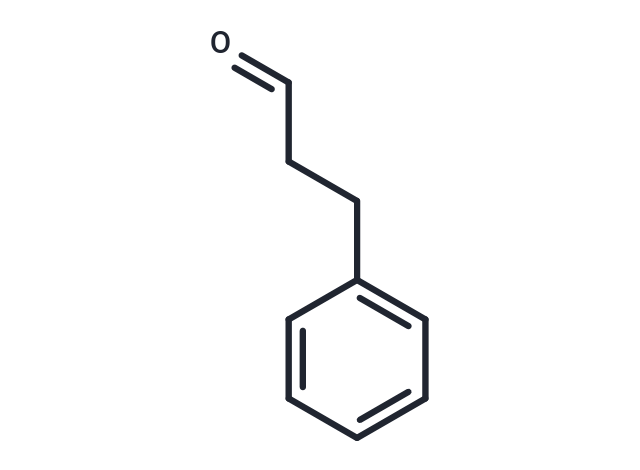
3-Phenylpropanal
CAS No. 104-53-0
3-Phenylpropanal( —— )
Catalog No. M33664 CAS No. 104-53-0
3-Phenylpropanal (Phenylpropyl aldehyde) is a RIFM flavor ingredient and can be used to make perfume.3-Phenylpropanal is the main ingredient in acaricides.
Purity : >98% (HPLC)
 COA
Datasheet
HNMR
HPLC
MSDS
Handing Instructions
COA
Datasheet
HNMR
HPLC
MSDS
Handing Instructions
| Size | Price / USD | Stock | Quantity |
| 5MG | 48 | In Stock |


|
| 10MG | 67 | In Stock |
|
| 25MG | 104 | In Stock |
|
| 50MG | 154 | In Stock |
|
| 100MG | 223 | In Stock |
|
| 500MG | 557 | In Stock |
|
| 1G | Get Quote | In Stock |
|
Biological Information
-
Product Name3-Phenylpropanal
-
NoteResearch use only, not for human use.
-
Brief Description3-Phenylpropanal (Phenylpropyl aldehyde) is a RIFM flavor ingredient and can be used to make perfume.3-Phenylpropanal is the main ingredient in acaricides.
-
Description3-Phenylpropanal (Phenylpropyl aldehyde) is a RIFM flavor ingredient and can be used to make perfume.3-Phenylpropanal is the main ingredient in acaricides.3-Phenylpropanal can be used as a fly attractant.3-Phenylpropanal can be used as an insecticide.
-
In Vitro——
-
In Vivo——
-
Synonyms——
-
PathwayOthers
-
TargetOther Targets
-
RecptorOthers
-
Research Area——
-
Indication——
Chemical Information
-
CAS Number104-53-0
-
Formula Weight134.18
-
Molecular FormulaC9H10O
-
Purity>98% (HPLC)
-
Solubility——
-
SMILESO=CCCc1ccccc1
-
Chemical Name——
Shipping & Storage Information
-
Storage(-20℃)
-
ShippingWith Ice Pack
-
Stability≥ 2 years
Reference
molnova catalog



related products
-
RGW 611
Detail unknown.
-
CTP Synthetase-IN-1
CTP Synthetase-IN-1 is an orally active and potent cytidine 5'-triphosphate synthetase (CTPS) inhibitor with potential antitumour activity, shows anti-inflammatory activity in animal models of inflammation, inhibits human CTPS1 and human CTPS2, and can be used in studies of arthritis and rheumatoid arthritis.
-
dCeMM1
dCeMM1, a RBM39 glue degrader, re-directs the activity of the CRL4DCAF15 ligase and decreases RBM39 expression levels in WT KBM7 cells.
