


 Cart
Cart
 sales@molnova.com



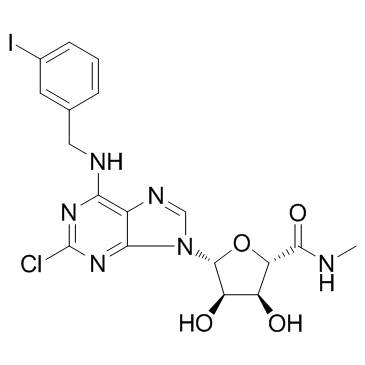
2-Cl-IB-MECA
CAS No. 163042-96-4
2-Cl-IB-MECA( Cl-IB-MECA | CF-102 | Namodenoson )
Catalog No. M12449 CAS No. 163042-96-4
2-Cl-IB-MECA (Chloro-IB-MECA, CF-102, Namodenoson) is a potent, selective A3 adenosine receptor agonist with Ki of 0.33 nM, 2500- and 1400-fold selectivity over A1 and A2a receptors.
Purity : >98% (HPLC)
 COA
Datasheet
HNMR
HPLC
MSDS
Handing Instructions
COA
Datasheet
HNMR
HPLC
MSDS
Handing Instructions
| Size | Price / USD | Stock | Quantity |
| 5MG | 65 | In Stock |


|
| 10MG | 110 | In Stock |
|
| 25MG | 222 | In Stock |
|
| 50MG | 357 | In Stock |
|
| 100MG | 537 | In Stock |
|
| 200MG | Get Quote | In Stock |
|
| 500MG | Get Quote | In Stock |
|
| 1G | Get Quote | In Stock |
|
Biological Information
-
Product Name2-Cl-IB-MECA
-
NoteResearch use only, not for human use.
-
Brief Description2-Cl-IB-MECA (Chloro-IB-MECA, CF-102, Namodenoson) is a potent, selective A3 adenosine receptor agonist with Ki of 0.33 nM, 2500- and 1400-fold selectivity over A1 and A2a receptors.
-
Description2-Cl-IB-MECA (Chloro-IB-MECA, CF-102, Namodenoson) is a potent, selective A3 adenosine receptor agonist with Ki of 0.33 nM, 2500- and 1400-fold selectivity over A1 and A2a receptors; also displays 46,000-fold selectivity versus the Na(+)-independent adenosine transporter; inhibits adenylate cyclase via rat A3 receptors in CHO cells (IC50=67 nM); induces apoptosis in HL-60 cells at concentrations of <30 uM, significantly induced Ca(2+) release from intracellular Ca(2+) pools followed by Ca(2+) influx; increases plasma histamine concentrations in conscious rats.Liver Cancer Phase 2 Clinical(In Vitro):In human ADF cells of astroglial lineage, 100 nM Namodenoson (2-Cl-IB-MECA) caused a marked reorganization of the cytoskeleton, with appearance of stress fibres and numerous cell protrusions. High concentrations of Namodenoson (2-Cl-IB-MECA) directly cause influx of Ca2+.(In Vivo):Intravenous administration of 200 μg/kg Namodenoson (2-Cl-IB-MECA) resulted in a short-lasting hypotension, which was accompanied by a 50-100-fold increase in plasma histamine concentrations. Administration of a second dose of Namodenoson (2-Cl-IB-MECA) did not elicit any hemodynamic effects.
-
In VitroIn human ADF cells of astroglial lineage, 100 nM Namodenoson (2-Cl-IB-MECA) caused a marked reorganization of the cytoskeleton, with appearance of stress fibres and numerous cell protrusions. High concentrations of Namodenoson (2-Cl-IB-MECA) directly cause influx of Ca2+.
-
In VivoIntravenous administration of 200 μg/kg Namodenoson (2-Cl-IB-MECA) resulted in a short-lasting hypotension, which was accompanied by a 50-100-fold increase in plasma histamine concentrations. Administration of a second dose of Namodenoson (2-Cl-IB-MECA) did not elicit any hemodynamic effects.
-
SynonymsCl-IB-MECA | CF-102 | Namodenoson
-
PathwayGPCR/G Protein
-
TargetAdenosine Receptor
-
RecptorAdenosine Receptor
-
Research AreaCancer
-
IndicationLiver Cancer
Chemical Information
-
CAS Number163042-96-4
-
Formula Weight544.7308
-
Molecular FormulaC18H18ClIN6O4
-
Purity>98% (HPLC)
-
SolubilityDMSO: ≥ 31 mg/mL
-
SMILESO[C@H]1[C@H](N2C=NC3=C(NCC4=CC=CC(I)=C4)N=C(Cl)N=C23)O[C@H](C(NC)=O)[C@H]1O
-
Chemical Nameβ-D-Ribofuranuronamide, 1-[2-chloro-6-[[(3-iodophenyl)methyl]amino]-9H-purin-9-yl]-1-deoxy-N-methyl-
Shipping & Storage Information
-
Storage(-20℃)
-
ShippingWith Ice Pack
-
Stability≥ 2 years
Reference
1. Van Schaick EA, et al. Eur J Pharmacol. 1996 Jul 25;308(3):311-4.
2. Kim HO, et al. J Med Chem. 1994 Oct 14;37(21):3614-21.
3. Kohno Y, et al. Biochem Biophys Res Commun. 1996 Feb 27;219(3):904-10.
4. Dunwiddie TV, et al. J Neurosci. 1997 Jan 15;17(2):607-14.
molnova catalog



related products
-
CGS 21680 hydrochlor...
CGS 21680 is a specific adenosine A2A subtype receptor agonist with Ki of 27 nM.
-
ISAM-140
ISAM-140 is a potent and highly selective antagonist of A2B adenosine receptor.
-
Sonedenoson
Sonedenoson (MRE0094) is an adenosine A(2A) receptor agonist and potential inhibitor potentially targeting SARS-CoV-2 coronavirus 2;-O-ribose methyltransferase, and may be used in the study of diabetic foot ulcers.
