


 Cart
Cart
 sales@molnova.com



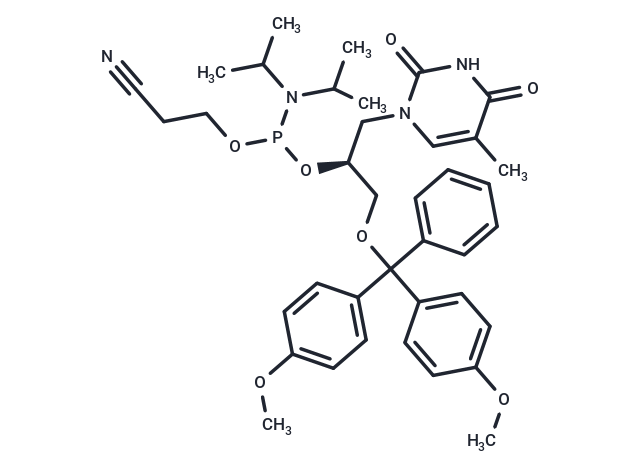
(S)-GNA-T-phosphoramidite
CAS No. 168332-13-6
(S)-GNA-T-phosphoramidite( —— )
Catalog No. M37910 CAS No. 168332-13-6
(S)-GNA-T-phosphoramidite is a nucleoside analog commonly used in the synthesis of other active compounds.
Purity : >98% (HPLC)
 COA
Datasheet
HNMR
HPLC
MSDS
Handing Instructions
COA
Datasheet
HNMR
HPLC
MSDS
Handing Instructions
| Size | Price / USD | Stock | Quantity |
| 2MG | 70 | Get Quote |


|
| 5MG | 92 | Get Quote |
|
| 10MG | 145 | Get Quote |
|
| 25MG | 236 | Get Quote |
|
| 50MG | 352 | Get Quote |
|
| 100MG | 521 | Get Quote |
|
| 500MG | 1134 | Get Quote |
|
| 1G | Get Quote | Get Quote |
|
Biological Information
-
Product Name(S)-GNA-T-phosphoramidite
-
NoteResearch use only, not for human use.
-
Brief Description(S)-GNA-T-phosphoramidite is a nucleoside analog commonly used in the synthesis of other active compounds.
-
Description(S)-GNA-T-phosphoramidite is a nucleoside analog commonly used in the synthesis of other active compounds.
-
In Vitro——
-
In Vivo——
-
Synonyms——
-
PathwayMicrobiology/Virology
-
TargetAntibiotic
-
RecptorNucleoside Antimetabolite/Analog
-
Research Area——
-
Indication——
Chemical Information
-
CAS Number168332-13-6
-
Formula Weight702.78
-
Molecular FormulaC38H47N4O7P
-
Purity>98% (HPLC)
-
Solubility——
-
SMILESC(OC[C@@H](OP(N(C(C)C)C(C)C)OCCC#N)CN1C(=O)NC(=O)C(C)=C1)(C2=CC=C(OC)C=C2)(C3=CC=C(OC)C=C3)C4=CC=CC=C4
-
Chemical Name——
Shipping & Storage Information
-
Storage(-20℃)
-
ShippingWith Ice Pack
-
Stability≥ 2 years
Reference
molnova catalog



related products
-
Lasalocid A ammonium
Lasalocid A ammonium is an amine-selective ion carrier and feed additive with antimicrobial activity and antibiotic, growth-promoting properties, inhibits the protozoa of falciparum malaria, and can be used in the study of microbial infections.
-
Nifursemizone
Nifursemizone is an agent with antiprotozoal.
-
3-Deoxy-3-fluoroaden...
3'-Deoxy-3'-fluoroadenosine is a purine nucleoside analogue with broad anti-tumor and anti-viral activity, showing inhibitory effects on tick-borne encephalitis virus (TBEV), Zika virus, and West Nile virus (WNV) with EC50 values of 1.1 μM, 0.1 μM and [4.7 ± 1.5] μM, respectively.
