


 Cart
Cart
 sales@molnova.com



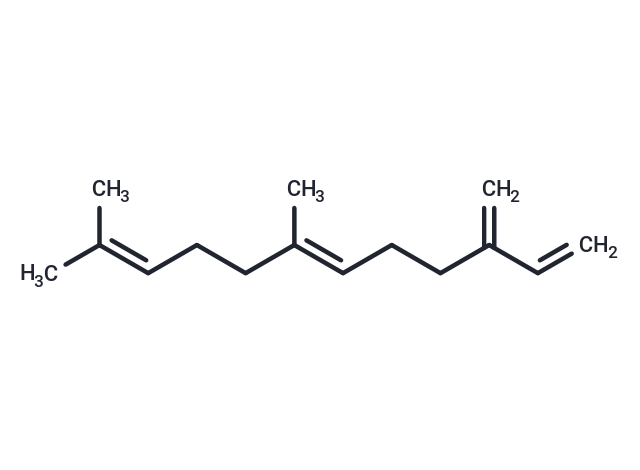
(E)-β-Farnesene
CAS No. 18794-84-8
(E)-β-Farnesene( —— )
Catalog No. M37792 CAS No. 18794-84-8
(E)-β-Farnesene (trans-β-Farnesene) is a sesquiterpene hydrocarbon found in Phlomis aurea Decne, serving as the primary component of many aphid alarm pheromones that disrupt feeding.
Purity : >98% (HPLC)
 COA
Datasheet
HNMR
HPLC
MSDS
Handing Instructions
COA
Datasheet
HNMR
HPLC
MSDS
Handing Instructions
| Size | Price / USD | Stock | Quantity |
| 50MG | 28 | Get Quote |


|
| 100MG | 36 | Get Quote |
|
| 500MG | 76 | Get Quote |
|
| 1G | 111 | Get Quote |
|
Biological Information
-
Product Name(E)-β-Farnesene
-
NoteResearch use only, not for human use.
-
Brief Description(E)-β-Farnesene (trans-β-Farnesene) is a sesquiterpene hydrocarbon found in Phlomis aurea Decne, serving as the primary component of many aphid alarm pheromones that disrupt feeding.
-
Description(E)-β-Farnesene (trans-β-Farnesene) is a volatile sesquiterpene hydrocarbon which can be found in Phlomis aurea Decne essential oil. (E)-β-Farnesene can be used as a feeding stimulant for the sand fly Lutzomyia longipalpis.
-
In Vitro——
-
In Vivo——
-
Synonyms——
-
PathwayMicrobiology/Virology
-
TargetAntifungal
-
RecptorAntifungal
-
Research Area——
-
Indication——
Chemical Information
-
CAS Number18794-84-8
-
Formula Weight204.35
-
Molecular FormulaC15H24
-
Purity>98% (HPLC)
-
SolubilityIn Vitro:?DMSO : 33.33 mg/mL (163.10 mM; Ultrasonic )
-
SMILESCC(C)=CCC\C(C)=C\CCC(=C)C=C
-
Chemical Name——
Shipping & Storage Information
-
Storage(-20℃)
-
ShippingWith Ice Pack
-
Stability≥ 2 years
Reference
1. Tesh RB, et, al. Trans-beta-farnesene as a feeding stimulant for the sand fly Lutzomyia longipalpis (Diptera: Psychodidae). J Med Entomol. 1992 Mar;29(2):226-31. ?
molnova catalog



related products
-
WAY-324208
WAY-324208 shows antifungal properties against S. dermatitidis (skin-infecting fungi), with activity against other fungi to be explored.
-
Isocorypalmine
(-)-Isocorypalmine, a natural product isolated from Corydalis chaerophylla, has significant antifungal activity.
-
Columbianetin
Columbianetin is a new phytoalexin associated with celery (Apium graveolens) resistance to pathogens during storage it also has antifungal activity. Columbianetin has anti-inflammatory effects it promotes histamine release and inhibits the histamine release by substance P suggests that it may be helpful in regulating mast cell-mediated allergic inflammatory responses. (2'S)-columbianetin can be effectively used to protect keratinocytes from UVB induced damage.
