


 Cart
Cart
 sales@molnova.com



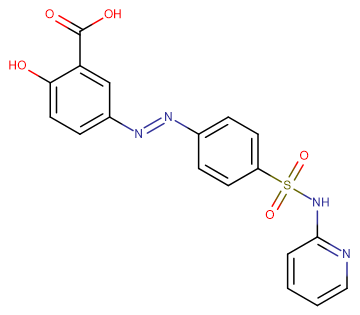
Sulfasalazine
CAS No. 599-79-1
Sulfasalazine( Azopyrin | NSC 203730 | NSC 667219 )
Catalog No. M15233 CAS No. 599-79-1
Sulfasalazine, a sulfa agent and a derivative of mesalazine, is used primarily as an anti-inflammatory agent.
Purity : >98% (HPLC)
 COA
Datasheet
HNMR
HPLC
MSDS
Handing Instructions
COA
Datasheet
HNMR
HPLC
MSDS
Handing Instructions
| Size | Price / USD | Stock | Quantity |
| 500MG | 41 | In Stock |


|
| 1G | 48 | In Stock |
|
Biological Information
-
Product NameSulfasalazine
-
NoteResearch use only, not for human use.
-
Brief DescriptionSulfasalazine, a sulfa agent and a derivative of mesalazine, is used primarily as an anti-inflammatory agent.
-
DescriptionSulfasalazine, a sulfa agent and a derivative of mesalazine, is used primarily as an anti-inflammatory agent. Target: Others Sulfasalazine (Azulfidine), used to treat pain and swelling in arthritis, belongs to a class of drugs called sulfa drugs.(In Vitro):Treatment of SW620 colon cells with sulfasalazine inhibits TNFα-, LPS-, or phorbol ester-induced NFκB activation. NFκB-dependent transcription is inhibited by sulfasalazine at micro- to millimolar concentrations. TNFα-induced nuclear translocation of NFκB is prevented by sulfasalazine through inhibition of IκBα degradation. Pre-incubation with 5 mM of sulfasalazine alone significantly increases basal mRNA expression of all pro-inflammatory cytokines with levels of IL-6 mRNA increased by 80-fold compared with vehicle control. Once digested, sulfasalazine is cleaved into sulfapyridine and 5-aminosalicylic acid by colonic bacteria, and the latter, too, is reported to suppress NF-kappaB activity.(In Vivo):At low doses (0.25 mM), SAS is able to suppress glioma growth by over 60% compared to untreated controls.
-
In VitroTreatment of SW620 colon cells with sulfasalazine inhibits TNFα-, LPS-, or phorbol ester-induced NFκB activation. NFκB-dependent transcription is inhibited by sulfasalazine at micro- to millimolar concentrations. TNFα-induced nuclear translocation of NFκB is prevented by sulfasalazine through inhibition of IκBα degradation. Pre-incubation with 5 mM of sulfasalazine alone significantly increases basal mRNA expression of all pro-inflammatory cytokines with levels of IL-6 mRNA increased by 80-fold compared with vehicle control. Once digested, sulfasalazine is cleaved into sulfapyridine and 5-aminosalicylic acid by colonic bacteria, and the latter, too, is reported to suppress NF-kappaB activity.
-
In VivoAt low doses (0.25 mM), SAS is able to suppress glioma growth by over 60% compared to untreated controls.
-
SynonymsAzopyrin | NSC 203730 | NSC 667219
-
PathwayChromatin/Epigenetic
-
TargetCOX
-
RecptorCOX-1| COX-2| NF-κB
-
Research AreaInflammation/Immunology
-
Indication——
Chemical Information
-
CAS Number599-79-1
-
Formula Weight398.39
-
Molecular FormulaC18H14N4O5S
-
Purity>98% (HPLC)
-
SolubilityDMSO: 80 mg/mL (200.8 mM)
-
SMILESO=C(O)C1=CC(/N=N/C2=CC=C(S(=O)(NC3=NC=CC=C3)=O)C=C2)=CC=C1O
-
Chemical Name(E)-2-hydroxy-5-((4-(N-(pyridin-2-yl)sulfamoyl)phenyl)diazenyl)benzoic acid
Shipping & Storage Information
-
Storage(-20℃)
-
ShippingWith Ice Pack
-
Stability≥ 2 years
Reference
1.Weber CK, et al. Gastroenterology. 2000 Nov;119(5):1209-18.
molnova catalog



related products
-
Apyramide
Apyramide is an anti-inflammatory agent (NSAID) that acts as a prodrug of indomethacin, a potent, blood-brain permeable, and nonselective inhibitor of COX1 and COX2.
-
PTUPB
PTUPB is a novel dual acting COX-2/sEH inhibitor with IC50 of 1.26 uM/0.9 nM.
-
COX-2-IN-6
COX-2-IN-6 is a potent, selective, and orally available cyclooxygenase-2 (COX-2) inhibitor with an IC50 of 0.84 μM and a Ki of 69 nM.COX-2-IN-6 inhibits COX-2-driven PGE2 synthesis with an IC50 of 0.60 μM.COX-2-IN-6 is used to prevent colorectal cancer.
