


 Cart
Cart
 sales@molnova.com



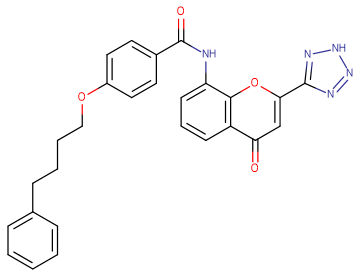
Pranlukast
CAS No. 103177-37-3
Pranlukast( ONO-1078 | Ultair )
Catalog No. M10154 CAS No. 103177-37-3
Pranlukast is a cysteinyl leukotriene receptor-1 antagonist.
Purity : >98% (HPLC)
 COA
Datasheet
HNMR
HPLC
MSDS
Handing Instructions
COA
Datasheet
HNMR
HPLC
MSDS
Handing Instructions
| Size | Price / USD | Stock | Quantity |
| 25MG | 45 | In Stock |


|
| 50MG | 65 | In Stock |
|
| 100MG | 81 | In Stock |
|
| 200MG | 116 | In Stock |
|
| 500MG | Get Quote | In Stock |
|
| 1G | Get Quote | In Stock |
|
Biological Information
-
Product NamePranlukast
-
NoteResearch use only, not for human use.
-
Brief DescriptionPranlukast is a cysteinyl leukotriene receptor-1 antagonist.
-
DescriptionPranlukast is a cysteinyl leukotriene receptor-1 antagonist. It antagonizes or reduces bronchospasm caused, principally in asthmatics, by an allergic reaction to accidentally or inadvertently encountered allergens. (In Vitro):In the radioligand binding assay, Pranlukast (ONO-1078) inhibits [3H]LTE4, [3H]LTD4, and [3H]LTC4 bindings to lung membranes with Kis of 0.63±0.11, 0.99±0.19, and 5640±680 nM, respectively. The antagonism of Pranlukast against [3H]LTD4 binding is competitive. In functional experiments, Pranlukast shows competitive antagonism against the LTC4- and LTD4-induced contractions of guinea pig trachea and lung parenchymal strips with a pA2 range of 7.70 to 10.71. In the presence of an inhibitor of the bioconversion of LTC4 to LTD4, Pranlukast also antagonizes the LTC4-induced contraction of guinea pig trachea (pA2=7.78). Pranlukast significantly reverses the LTD4-induced prolonged contraction without effect on the KCl- and BaCl2-induced contractions of guinea pig trachea. Oxygen-glucose deprivation (OGD)-induced nuclear translocation of CysLT1 receptors is inhibited by pretreatment with the CysLT1 receptor antagonist Pranlukast (10 μM). Pranlukast protects endothelial cells against ischemia-like injury. The effects of the CysLT1 receptor antagonist Pranlukast and the 5-lipoxygenase inhibitor Zileuton on translocation are also assessed. The results show that Pranlukast, but not Zileuton, inhibits the translocation of the CysLT1 receptor 6 h after OGD. (In Vivo):Carrageenan (CAR, 5 mg per mouse) is injected i.p. 24 h before LPS (50 p,g per mouse) is injected i.v. Various doses of Pranlukast (ONO-1078; 40, 20, and 10 mmol/kg), AA-861 (20, 10, and 5 mmol/kg), Indomethacin (40 mmollkg), and the controls are injected s.c. into mice 30 min before they are challenged with 50 p,g of LPS. The maximum soluble doses are 0.6 mmol/mL in 10% DMSO for AA-861 and 1.2 mmol/mL in 10% ethanol for Pranlukast. These solutions are used as the maximum doses for the treatments. The mortality of mice is significantly decreased in AA-861- Pranlukast-treated mice relative to that in the control mice. Pretreatment with CAR (5 mg i.p.) renders the mice more sensitive to the effect of LPS. Although the survival rate of mice treated with each solvent is 20% at 72 h after LPS (50 p,g per mouse) administration, s.c. treatment with AA-861 (20 mmol/kg) or Pranlukast (40 mmol/kg) significantly increases the survival rate after the LPS administration (AA-861, P<0.001; Pranlukast, P<0.01).
-
In VitroIn the radioligand binding assay, Pranlukast (ONO-1078) inhibits [3H]LTE4, [3H]LTD4, and [3H]LTC4 bindings to lung membranes with Kis of 0.63±0.11, 0.99±0.19, and 5640±680 nM, respectively. The antagonism of Pranlukast against [3H]LTD4 binding is competitive. In functional experiments, Pranlukast shows competitive antagonism against the LTC4- and LTD4-induced contractions of guinea pig trachea and lung parenchymal strips with a pA2 range of 7.70 to 10.71.In the presence of an inhibitor of the bioconversion of LTC4 to LTD4, Pranlukast also antagonizes the LTC4-induced contraction of guinea pig trachea (pA2=7.78). Pranlukast significantly reverses the LTD4-induced prolonged contraction without effect on the KCl- and BaCl2-induced contractions of guinea pig trachea. Oxygen-glucose deprivation (OGD)-induced nuclear translocation of CysLT1 receptors is inhibited by pretreatment with the CysLT1 receptor antagonist Pranlukast (10 μM). Pranlukast protects endothelial cells against ischemia-like injury. The effects of the CysLT1 receptor antagonist Pranlukast and the 5-lipoxygenase inhibitor Zileuton on translocation are also assessed. The results show that Pranlukast, but not Zileuton, inhibits the translocation of the CysLT1 receptor 6 h after OGD.
-
In VivoCarrageenan (CAR, 5 mg per mouse) is injected i.p. 24 h before LPS (50 p,g per mouse) is injected i.v. Various doses of Pranlukast (ONO-1078; 40, 20, and 10 mmol/kg), AA-861 (20, 10, and 5 mmol/kg), Indomethacin (40 mmollkg), and the controls are injected s.c. into mice 30 min before they are challenged with 50 p,g of LPS. The maximum soluble doses are 0.6 mmol/mL in 10% DMSO for AA-861 and 1.2 mmol/mL in 10% ethanol for Pranlukast. These solutions are used as the maximum doses for the treatments. The mortality of mice is significantly decreased in AA-861- Pranlukast-treated mice relative to that in the control mice. Pretreatment with CAR (5 mg i.p.) renders the mice more sensitive to the effect of LPS. Although the survival rate of mice treated with each solvent is 20% at 72 h after LPS (50 p,g per mouse) administration, s.c. treatment with AA-861 (20 mmol/kg) or Pranlukast (40 mmol/kg) significantly increases the survival rate after the LPS administration (AA-861, P<0.001; Pranlukast, P<0.01).
-
SynonymsONO-1078 | Ultair
-
PathwayApoptosis
-
TargetIL Receptor
-
RecptorIL-5| CysLTR| NF-κB| Eosinophil cationic protein| Mucin-2| TNF-α
-
Research AreaInflammation/Immunology
-
Indication——
Chemical Information
-
CAS Number103177-37-3
-
Formula Weight481.5
-
Molecular FormulaC27H23N5O4
-
Purity>98% (HPLC)
-
SolubilityDMSO: 11mg/ml (22.85 mM); Water: <1mg/ml; Ethanol: <1mg/ml
-
SMILESC1=CC=C(C=C1)CCCCOC2=CC=C(C=C2)C(=O)NC3=CC=CC4=C3OC(=CC4=O)C5=NNN=N5
-
Chemical NameN-[4-oxo-2-(2H-tetrazol-5-yl)chromen-8-yl]-4-(4-phenylbutoxy)benzamide
Shipping & Storage Information
-
Storage(-20℃)
-
ShippingWith Ice Pack
-
Stability≥ 2 years
Reference
1.Yoo SH, et al. Respirology. 2001 Mar;6(1):15-2
molnova catalog



related products
-
LMT-28
LMT-28 (LMT28) is a specific blocker of IL-6 signaling via inhibits IL-6Rβ (gp130) with IC50 of 5.9 uM (IL-6–induced luciferase activity).
-
YM-90709
A potent IL-5 receptor antagonist that inhibits the binding of IL-5 to its receptor on peripheral human eosinophils and butyric acid-treated eosinophilic HL-60 clone 15 cells with IC50 of 1.0 and 0.57 uM, respectively.
-
Guselkumab
Guselkumab (CNTO 1959) is a recombinant human IgG1 monoclonal antibody targeting the IL-23p19 subunit.
