


 Cart
Cart
 sales@molnova.com



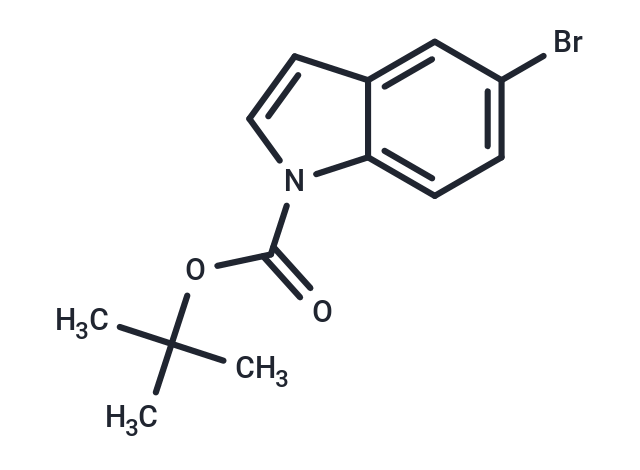
tert-Butyl5-bromo-1H-indole-1-carboxylate
CAS No. 182344-70-3
tert-Butyl5-bromo-1H-indole-1-carboxylate( —— )
Catalog No. M36863 CAS No. 182344-70-3
Tert-Butyl5-bromo-1H-indole-1-carboxylate (N-Boc-5-bromoindole) is an indole derivative with therapeutic potential for pain, inflammation, and other conditions.
Purity : >98% (HPLC)
 COA
Datasheet
HNMR
HPLC
MSDS
Handing Instructions
COA
Datasheet
HNMR
HPLC
MSDS
Handing Instructions
| Size | Price / USD | Stock | Quantity |
| 100MG | Get Quote | In Stock |


|
| 200MG | Get Quote | In Stock |
|
| 500MG | Get Quote | In Stock |
|
| 1G | 27 | In Stock |
|
Biological Information
-
Product Nametert-Butyl5-bromo-1H-indole-1-carboxylate
-
NoteResearch use only, not for human use.
-
Brief DescriptionTert-Butyl5-bromo-1H-indole-1-carboxylate (N-Boc-5-bromoindole) is an indole derivative with therapeutic potential for pain, inflammation, and other conditions.
-
DescriptionTert-Butyl5-bromo-1H-indole-1-carboxylate (N-Boc-5-bromoindole) is an indole derivative with therapeutic potential for pain, inflammation, and other conditions.
-
In Vitro——
-
In Vivo——
-
Synonyms——
-
PathwayOthers
-
TargetOther Targets
-
RecptorOthers
-
Research Area——
-
Indication——
Chemical Information
-
CAS Number182344-70-3
-
Formula Weight296.16
-
Molecular FormulaC13H14BrNO2
-
Purity>98% (HPLC)
-
Solubility——
-
SMILESCC(C)(C)OC(=O)N1C=CC2=CC(Br)=CC=C12
-
Chemical Name——
Shipping & Storage Information
-
Storage(-20℃)
-
ShippingWith Ice Pack
-
Stability≥ 2 years
Reference
molnova catalog



related products
-
Heliosupine N-oxide
Heliosupine N-oxide Description.
-
Neuronostatin-13 (mo...
Neuronostatin-13 (mouse, rat)
-
PF-05231023
PF-05231023 is a long-acting fibroblast growth factor 21 (FGF21) analog and is an FGF21-receptor agonist. It is also suitable for development as a potential treatment for T2DM. PF-05231023 is a analog of long-acting fibroblast growth factor 21.
