


 Cart
Cart
 sales@molnova.com



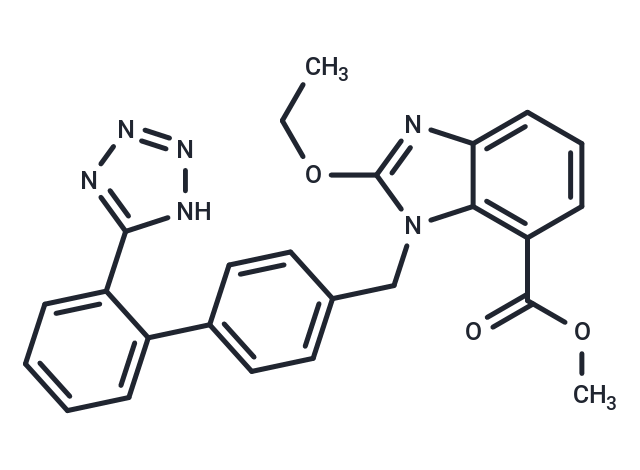
Methyl candesartan
CAS No. 139481-69-9
Methyl candesartan( —— )
Catalog No. M35877 CAS No. 139481-69-9
Methyl candesartan (Candesartan Methyl Ester) is a potent angiotensin 2 receptor antagonist used in the study of hypertension.
Purity : >98% (HPLC)
 COA
Datasheet
HNMR
HPLC
MSDS
Handing Instructions
COA
Datasheet
HNMR
HPLC
MSDS
Handing Instructions
| Size | Price / USD | Stock | Quantity |
| 50MG | 33 | In Stock |


|
| 100MG | 47 | In Stock |
|
| 200MG | Get Quote | In Stock |
|
| 500MG | 114 | In Stock |
|
| 1G | Get Quote | In Stock |
|
Biological Information
-
Product NameMethyl candesartan
-
NoteResearch use only, not for human use.
-
Brief DescriptionMethyl candesartan (Candesartan Methyl Ester) is a potent angiotensin 2 receptor antagonist used in the study of hypertension.
-
DescriptionMethyl candesartan (Candesartan Methyl Ester) is a potent angiotensin 2 receptor antagonist used in the study of hypertension.
-
In Vitro——
-
In Vivo——
-
Synonyms——
-
PathwayEndocrinology/Hormones
-
TargetRAAS
-
RecptorRAAS
-
Research Area——
-
Indication——
Chemical Information
-
CAS Number139481-69-9
-
Formula Weight454.48
-
Molecular FormulaC25H22N6O3
-
Purity>98% (HPLC)
-
Solubility——
-
SMILESCCOc1nc2cccc(C(=O)OC)c2n1Cc1ccc(cc1)-c1ccccc1-c1nnn[nH]1
-
Chemical Name——
Shipping & Storage Information
-
Storage(-20℃)
-
ShippingWith Ice Pack
-
Stability≥ 2 years
Reference
molnova catalog



related products
-
Angiotensin (1-7) ac...
Angiotensin (1-7) acetate (Ang-(1-7) acetate) is an amino acid sequence present in angiotensin, which has antifibrotic and cardioprotective effects and inhibits the activity of purified canine angiotensin converting enzyme (ACE).
-
ZD 7155 hydrochlorid...
ZD 7155 hydrochloride is an angiotensin II receptor type 1 (AT1 receptor) antagonist.
-
Enalaprilat Dihydrat...
Enalaprilat is an angiotensin-converting enzyme (ACE) inhibitor with IC50 of 1.94 nM.
