


 Cart
Cart
 sales@molnova.com



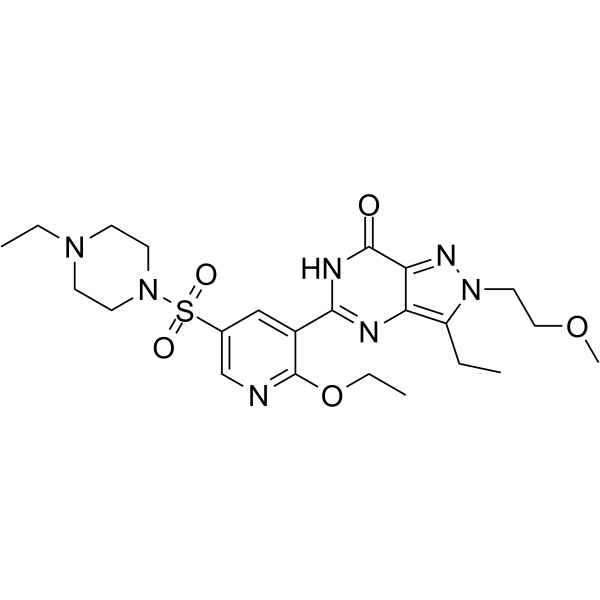
Gisadenafil
CAS No. 334826-98-1
Gisadenafil( UK-369003 )
Catalog No. M26695 CAS No. 334826-98-1
Gisadenafil is a selective inhibitor of phosphodiesterase 5 (PDE5) with an IC50 of 3.6 nM and prevents degradation of cGMP.
Purity : >98% (HPLC)
 COA
Datasheet
HNMR
HPLC
MSDS
Handing Instructions
COA
Datasheet
HNMR
HPLC
MSDS
Handing Instructions
| Size | Price / USD | Stock | Quantity |
| 5MG | 393 | Get Quote |


|
| 10MG | 581 | Get Quote |
|
| 25MG | 888 | Get Quote |
|
| 50MG | 1242 | Get Quote |
|
| 100MG | 1674 | Get Quote |
|
| 200MG | Get Quote | Get Quote |
|
| 500MG | Get Quote | Get Quote |
|
| 1G | Get Quote | Get Quote |
|
Biological Information
-
Product NameGisadenafil
-
NoteResearch use only, not for human use.
-
Brief DescriptionGisadenafil is a selective inhibitor of phosphodiesterase 5 (PDE5) with an IC50 of 3.6 nM and prevents degradation of cGMP.
-
DescriptionGisadenafil is a selective inhibitor of phosphodiesterase 5 (PDE5) with an IC50 of 3.6 nM and prevents degradation of cGMP.(In Vitro):In COS-7 cells, the IC50 of Gisadenafil for PDE1A is 9.1 μM, an approximately 2500-fold difference in selectivity.(In Vivo):In male Tat-transgenic mice, Gisadenafil (2 mg/kg; i.p.) restores the dilation of small (<25 μm) arterioles following hypercapnia, although it fails to restore full dilation of larger (>25 μm) vessels. Gisadenafil largely restores the normal increase in cortical flow following hypercapnia in Tat-tg mice (17.5% above baseline).
-
In VitroSince some PDE5 inhibitors can also interact with PDE1 isotypes found within the cerebral vasculature, the specificity of Gisadenafil for PDE5 is confirmed. This is directly tested with recombinant PDE5A and PDE1A overexpressed in COS-7 cells. The IC50 of Gisadenafil for PDE5A is 3.6 nM. In contrast, the IC50 of Gisadenafil for PDE1A is 9.1 μM, an approximately 2500-fold difference in specificity.
-
In VivoGisadenafil (2 mg/kg; intraperitoneal injection; for 2 hours; male Tat-transgenic mice) treatment largely restores the normal increase in cortical flow following hypercapnia in Tat-tg mice (17.5% above baseline). Gisadenafil also restores the dilation of small (<25 μm) arterioles following hypercapnia, although it fails to restore full dilation of larger (>25 μm) vessels. Animal Model:Male Tat-transgenic (Tat-tg) mice (8 weeks old) exposed to hypercapnia Dosage:2 mg/kg Administration:Intraperitoneal injection; for 2 hours Result:Largely restored the normal increase in cortical flow following hypercapnia in Tat-tg mice (17.5% above baseline). Also restored the dilation of small (<25 μm) arterioles following hypercapnia.
-
SynonymsUK-369003
-
PathwayAngiogenesis
-
TargetPDE
-
RecptorEstrogen Receptor/ERR| Human Endogenous Metabolite
-
Research Area——
-
Indication——
Chemical Information
-
CAS Number334826-98-1
-
Formula Weight519.62
-
Molecular FormulaC23H33N7O5S
-
Purity>98% (HPLC)
-
Solubility——
-
SMILESCCOc1ncc(cc1-c1nc2c(CC)n(CCOC)nc2c(=O)[nH]1)S(=O)(=O)N1CCN(CC)CC1
-
Chemical Name——
Shipping & Storage Information
-
Storage(-20℃)
-
ShippingWith Ice Pack
-
Stability≥ 2 years
Reference
1.Choi HJ, et al. 4-Hydroxyestrone, an Endogenous Estrogen Metabolite, Can Strongly Protect Neuronal Cells Against Oxidative Damage. Sci Rep. 2020 Apr 29;10(1):7283.
molnova catalog



related products
-
Aminophylline
Aminophylline is a competitive nonselective phosphodiesterase inhibitor that is used to treat airway obstruction from asthma or COPD.
-
ML-030
ML-030 is a potent and selective inhibitor of PDE4(PDE4A, PDE4A1, PDE4B1, PDE4B2, PDE4C1,and PDE4D2 with IC50 of 6.7 nM, 12.9 nM, 48.2 nM, 37.2 nM, 452 nM and 49.2 nM, respectively)
-
BC 11-38
BC 11-38 is a potent, selective PDE biodepressant which is mainly effective against PDE11 (IC50 : 0.28 μM).
