


 Cart
Cart
 sales@molnova.com



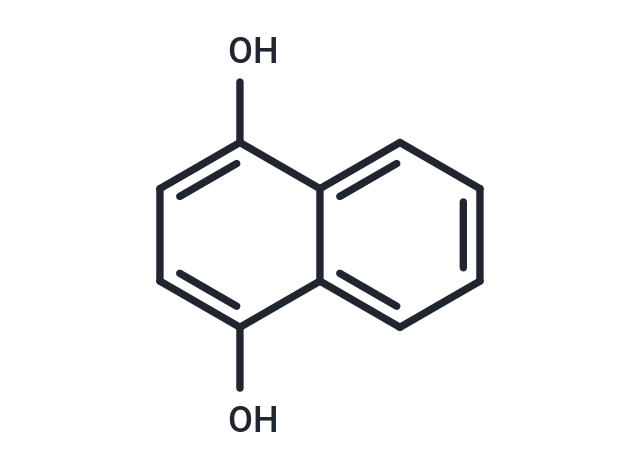
1,4-Dihydroxynaphthalene
CAS No. 571-60-8
1,4-Dihydroxynaphthalene( —— )
Catalog No. M37279 CAS No. 571-60-8
1,4-Dihydroxynaphthalene A potent HSV-1 protease inhibitor with inhibitory effects on the HCMV protease, which can be used to study herpesviruses.
Purity : >98% (HPLC)
 COA
Datasheet
HNMR
HPLC
MSDS
Handing Instructions
COA
Datasheet
HNMR
HPLC
MSDS
Handing Instructions
| Size | Price / USD | Stock | Quantity |
| 50MG | 28 | In Stock |


|
| 100MG | 41 | In Stock |
|
| 500MG | 84 | In Stock |
|
| 1G | 122 | In Stock |
|
Biological Information
-
Product Name1,4-Dihydroxynaphthalene
-
NoteResearch use only, not for human use.
-
Brief Description1,4-Dihydroxynaphthalene A potent HSV-1 protease inhibitor with inhibitory effects on the HCMV protease, which can be used to study herpesviruses.
-
Description1,4-Dihydroxynaphthalene A potent HSV-1 protease inhibitor with inhibitory effects on the HCMV protease, which can be used to study herpesviruses.
-
In Vitro——
-
In Vivo——
-
Synonyms——
-
PathwayMicrobiology/Virology
-
TargetHSV
-
RecptorHSV
-
Research Area——
-
Indication——
Chemical Information
-
CAS Number571-60-8
-
Formula Weight160.17
-
Molecular FormulaC10H8O2
-
Purity>98% (HPLC)
-
Solubility——
-
SMILESOc1ccc(O)c2ccccc12
-
Chemical Name——
Shipping & Storage Information
-
Storage(-20℃)
-
ShippingWith Ice Pack
-
Stability≥ 2 years
Reference
molnova catalog



related products
-
Aloe-emodin
Aloe-emodin is an interferon-inducing agent with IC50 of about 1 μg/mL for JEV and of about 0.33 μg/mL for EV71.
-
Fiacitabine
A synthesized pyrimidine analog that is a potent and selective anti-herpesvirus agent; suppresses various strains of HSV1 and HSV2 with IC90 of 2.5 nM and 12.6 nM, respectively.
-
Surfactin
Surfactin is a potent cyclic lipopeptide biosurfactants that mediates flux of mono-and divalent cations, such as calcium, across lipid bilayer membranes, with anti-bacterial, anti-fungal, antimycoplasma and hemolytic effects.Surfactin is used as a surfactant to mediate flux of mono-and divalent cations, such as calcium, across lipid bilayer membranes.?
